


People try very hard to change: Some change their sect or religion. Some change their wall paint or address. Some use cosmetics or get surgery. Perhaps you too have tried to change one way or another.
I know I have.
For example, I have always been the kid who didn’t play with other kids. As a teen, I was shy and didn’t have many friends. Around the age of 17 I decided that I wanted to change. So I started reading books and watching videos to teach me how to be more social. While I eventually got around to making friends, I never stopped being who I always was — an introverted and avoidant guy who still feels shy and reluctant to talk to strangers. Rather than changing in the sense of becoming the social butterfly, I just learned to socialise despite my inclination to be a recluse.
It’s not just me. Personality researchers call it “trait stability“. William James, often credited as the father of American psychology, stated that character is “set like plaster” by around age thirty. Further findings show that even in cases where people’s character or personality traits drift slightly with age, their position relative to everyone else stays remarkably consistent. That’s to say, if you’re more introverted than most people in your twenties, you’re very likely to still be more introverted than most people in your forties.
Does this mean there’s no such thing as change?
Think about it: like many people, I grew up with a religion I was mostly apatheistic about. Then I started taking it seriously and, in this case, became born again. However, over time, I started to question things and ended up agnostic. Similarly, I grew up in a household with no dietary restrictions. Then I stumbled upon some vegan programs on television and became vegan. But when I realised some chinks in the idea, I reverted back to being an omnivore. I could go on and on.
On the surface, it appears like I tried changing — tried being a Christian, or vegan — and failed. But, from my perspective, I made those transitions because of who I was on a deeper level. My quest for truth, meaning, and morality led me to Christianity, and eventually out of it. My quest for living in alignment with nature led me to veganism, and eventually out of it. The seeming changes were merely stages of growth and maturity.
All this is not to say there is nothing like change. Because how then do violent criminals become gentle, law-abiding citizens, addicts quit drugs, and unhappy people find joy and fulfilment in life? There must be a way for you to change your life for the better, especially if you are not really happy with where you are right now, right?
All of this is why I reached out to Chione Hardy to find out how we can change our lives.
About Chione Hardy
Chione Hardy is a Transformational Life Coach.
She has spent the past decade guiding people through change, while experiencing tremendous change herself.
She has worked with clients ranging from C-suite executives to teenagers.
And, over the years, she has collected and refined skills, tools, and practices such as Neuro-Linguistic Programming, Time Line Therapy, and Hypnotherapy that help bring change in people’s lives. She also has an Executive Coaching qualification from the University of Cambridge and a certification in Psychology for High Performance from Stanford.
All these and more she has under her belt.
But perhaps the most interesting thing about Chione, when it comes to the subject of change, isn’t just the tools she adopts, but her approach.
Chione was gracious enough to grant me an interview where we spoke for over an hour about the subject of change — not just in the motivational and philosophical sense, but within the practical, messy, and even broken societies we find ourselves in.
The rest of this piece is going to explore the ideas Chione shared, with some of my own thoughts overlaid.
Metamorphosis: How Change Happens
15:00 PM
I hear Chione’s voice, and soon she shows up on the screen. She is wearing a black lace top and a smile. We exchange pleasantries.
15:05 PM
I start recording, and we jump right into the conversation — Chione had requested that the conversation flow naturally rather than following a strict structure, and so we did just that.
You know, there is a lot of advice out there with promises of changing people’s lives. But when we look at the data, or at the people’s lives around us, we find that most of them don’t really live up to the hope or the hype. In fact, some seem to get worse, or lose so much, in the attempt to better their lives.
To this mismatch, Chione responded, “Only on the other side do I now see how a lot of the self-help advice enables dysfunction. A lot of it is framed around looking for and fixing problems. But when we spend so much time trying to find and fix what’s wrong, it becomes easy to fall into an identity of ‘everything is wrong, and everything needs to be fixed’.”
She went on to explain how this leads to people walking around with an “existential anxiety” — this uneasy feeling of “everything is wrong”. On the subconscious level, they may feel like where they are, or who they are at the moment, is not good enough, and that in the future, after the change, they will finally be in that place, or be that person, they really want to be.
But it is all backwards. Rather than chasing an ideal future, we all need to develop ourselves to be “pluralists” — in the sense that we can have desires and goals in the future, but then we don’t fixate on them to the point we ignore the present. Rather, we allow ourselves to actually let go of that desire entirely, to just let it be, while completely accepting what is in this current moment. This doesn’t mean you should do nothing about an undesirable situation — on the contrary, it means fully embracing it as yours, as who you are or where you are, and then working on it, rather than hating, ignoring, or feeling ashamed of it.
Why?
Because the thing that keeps us the most stagnant is shame — this feeling of inadequacy, this feeling of “what I am and who I am, and everything in my life, is not good enough”. So you have people who are actually distant from their own reality.
Yes, it is very difficult when someone is in a survival circumstance to release that shame. But there’s nothing shameful about being in a distressing situation. There’s nothing that someone should feel any kind of inadequacy about, being where they are — it’s just the reality of the situation. Whether it is their finances, relationships, or habits, it starts with accepting the situation. And then, from that acceptance, we start to open ourselves up and expand into the new. We start to expand our identity and expand our possibilities.
Rather than trying to escape or eliminate, change becomes a process of growth and expansion.
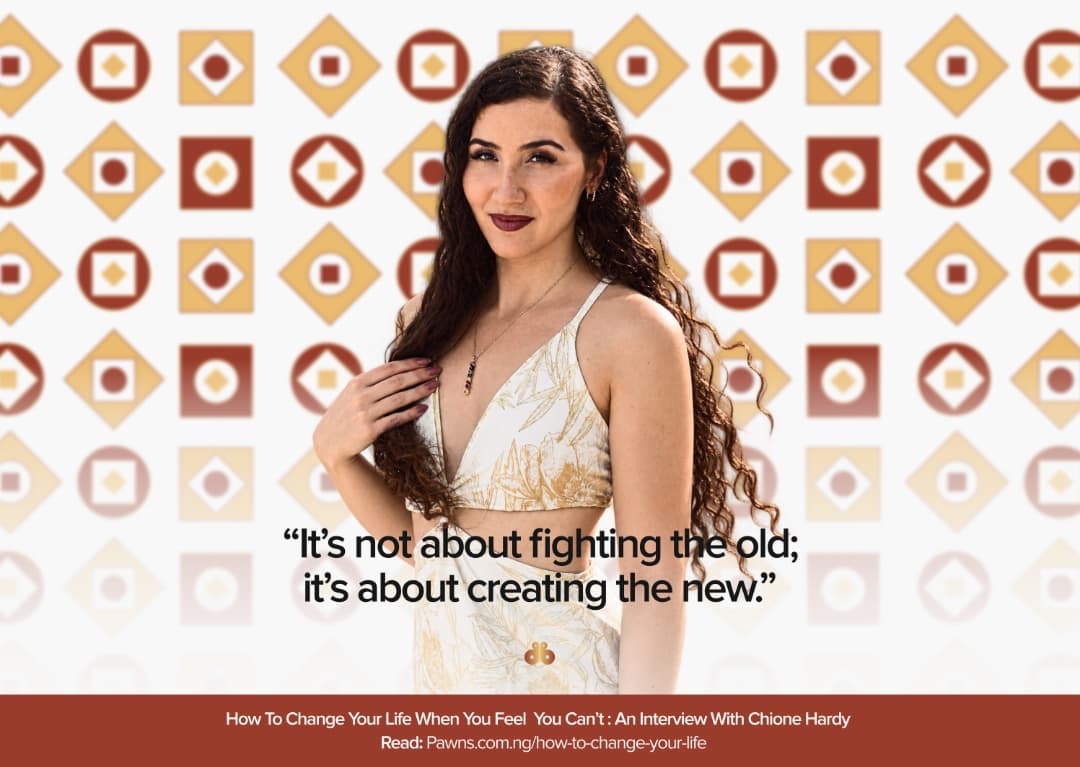
“It’s not about fighting the old; it’s about creating the new” – Chione Hardy
When she was explaining, my mind wandered to a poem I heard in the song “Mortal Man” by Kendrick Lamar. In the poem, Kendrick, using metaphor, explains how a caterpillar notices how much the world shuns it but praises the butterfly. And so it gets to work on the cocoon, surrounded by the dark and difficult reality it finds itself in. With time, it begins to develop wings and breaks free — so that in the end, even though the caterpillar and the butterfly are completely different, they are one and the same.
My attention drifts back to the conversation as Chione continued: “Life is to be experienced.”
She explained that we came here to have this experience, so all of our experiences are going to be unique. Whatever it is that we’re experiencing in this exact moment, life is giving us exactly what we need in order for us to evolve our consciousness.
When we keep running to the future, running to the past, or trying to completely understand the present, then we’re missing what is available right now. If we allow ourselves to relax — because it is actually about relaxing and trusting, realising that we’re safe in this moment — then we will have an idea come to us, or some kind of deeper understanding, or we’ll notice something in our environment which is literally exactly what we need.
Drawing from neuroscience, she elaborated on how a lot of times, when people are trying to transform, they’re trying to fix a problem, and so they’re always thinking, thinking, thinking, always analysing, operating from what they already know, trying to solve a problem with all the information they already have. Yet, when we let our mind be present, we open up the right side of the brain — the ability to be intuitive, the ability for our subconscious mind to produce a resolution for us without our effort.
Indeed, this is one of the inexplicable things about being a human being — we’re always able to receive that guidance, that intuition, as long as we remain in a receptive state, present and open to the possibilities.
“Trusting what it is that we’re becoming is the most valuable wisdom that we can have… in all aspects of our lives.” – Chione Hardy
Surrender: Why Change Often Seems Counter-Intuitive
15:32 PM
There is a power outage, and I am now in darkness. So I reach for my LED light. After a few seconds, she can see me again. We continue:
Society has a lot of demands and expectations, so it often feels scary or unusual to stop trying, relax and let go of control. In fact, it is the opposite of what we feel like doing.
Chione explained that trying to control things often makes it more difficult, or worse. For instance, in relationships, when someone is trying so hard to control the relationship, when they want it to be a certain way — so they demand too much from the other person, or give too much to the other person. Or, they stay closed off and don’t give enough of themselves to the other person, or ask for what they need. What you notice is that there’s an underlying fear — a fear of losing the other person, of vulnerability, or of getting hurt — so they try to control that fear instead of just opening themselves up and experiencing whatever happens if they simply be. And that costs them the relationship, or keeps them stuck in a circle of frustration.
She also explained how it plays out in business, especially if you’re trying to show up online. When you try so hard to relate and speak to people in a certain type of way — trying to be more professional, trying to appeal to the masses — you intentionally avoid talking about certain topics, or talk about things you don’t really resonate with. However, by doing that, you shut yourself off from who you are, and by extension, from the people who truly resonate with you. So you find yourself in a situation where you are actually limiting what you could offer to the people who need you.
As she spoke, the memory of a book I read many years ago popped up. It was The Surrender Experiment by Michael A. Singer. In the book, he shares his life story of how everything changed for the better when he stopped trying to control everything, let go of certainty, and simply opened himself up to whatever possibilities the universe presented. I share this with her. She nods in agreement.
Then she went on:
When we become even more ourselves, it filters our audience. The people who really understand and get what we’re talking about get drawn towards us, while those who don’t get repelled. This makes the people who really understand what we’re saying even more resonant. They connect even deeper with our message and who we are. That’s what actually creates trust and loyalty over time.
At this point, I couldn’t help but also think about the idea of Super Consumers, which I encountered reading the work of Category Pirates — Super Consumers being deeply passionate, highly engaged, and often obsessive customers. These are not people who buy necessarily because they need something, but because of who you are and what you represent. And that maps beautifully onto Simon Sinek’s idea of Starting With Why — the observation that people don’t buy what you sell; they buy why you sell it. In other words, by not being yourself fully, by trying to be someone else, you are hamstringing yourself.
“The easiest thing in the world is to be yourself. But most people have been taught to be someone they are not, which is actually the hardest way to be.” – Chione Hardy
Identity: The Only Way For Change To Be Sustainable
15:55 PM
Drawing from her experience as a coach, she explained that what she’s learned, and what she’s realised with so many high achievers, is that they build very successful businesses with the tools, strategies, and personas they pick up from others — but when they reach that pinnacle of success, they still feel hollow, still feel unfulfilled — because they created that business off of an inauthentic identity, instead of actually knowing who they are and then creating a business and a life around who they truly are and who they truly want to be.
Anything external that is not aligned with the internal is often unstable, unsustainable, unfulfilling. This is why you hear of lottery winners who win millions, but end up spending all of their money — because they haven’t actually changed who they are inside; or, more correctly, who they are on the inside is not aligned with the money they now have. So they just blow the money, because they have no financial consciousness in terms of how to manage it. The seeming change was external — they now have so much money — but they didn’t have the identity to hold it, so it slipped away.
The issue is rarely the relationship, business, money, or any of those external things. It is often a matter of the internal identity. But people struggle with this — they still want the tactics, titles, and numbers, because that is what society has conditioned them to value, so they try to be that way. They try to be a certain way in a relationship, in business, or even in their finances. They try to control and change the external.
But you have to let go of all that.
The transformation we seek does not come from the external.
It starts from within.
Instead of hiding, resisting, or rejecting parts of ourselves, we ought to accept, embrace, and embody what it could be. The work is often letting go of that conditioning — those years of expectations, demands, and frameworks — that keep you estranged from yourself.
It might be scary and hard, but you must understand that…
“…everything coming up to be cleared, to be healed, is not you. It never was. What is being cleared away is society’s conditioning. Once you understand this, you can move through that resistance with more ease, and those beliefs will dissolve. That’s when you will realise who you truly are underneath. It’s not hard to be yourself. It’s hard to be everyone else.” – Chione Hardy
Swimming Against the Tide: What To Do When Your Environment Won’t Let You Change
16:02 PM
“Our environment influences 80 percent of our ability to transform,” Chione stated, aphoristically.
Then she went on to explain that a lot of people resist change because of their relationship with their environment, not just the environment itself. They resist change because they subconsciously fear outgrowing the people around them, having to let go of certain relationships they care about, not knowing what’s on the other side of change.
“Our brain hates the unknown. It hates it. It wants to keep us safe… Even if your comfort zone is stress, discomfort, dis-ease, if that’s what you’re used to, then that’s where you’ll stay until you consciously make a decision to break out of that.” – Chione Hardy
As she explained, my mind drifted once more to the reality of the country I find myself in. Nigeria. Here, trying to change can sometimes cost you everything, including your life. People get cut off by their family for marrying who they don’t approve of, entire villages are massacred for choosing not to become jihadists, and even politicians who decide not to bribe or rig elections get mostly ignored, cheated out of the election, and mocked by the masses.
She empathised with the reality of my country and highlighted that while the responsibility of changing our lives is ours, it’s important to take into consideration if we’re in a broken system. It’s frustrating, and it’s so hard to swim against the tide. But what we all need to remember is that “whatever you’re thinking, other people [in Nigeria] are experiencing that as well,” she encouraged.
Indeed, there are other people within our own culture and our microcosm who are also experiencing whatever challenges we are facing. It might only be hard right now because we feel like we’re alone, that no one else hears us. But maybe you’re the first voice. Maybe you’re the voice who is going to be the pioneer. Maybe you’re the one who calls everyone to bring about the change — and maybe that is your transmission, your purpose.
Without discrediting how hard it is to change in certain environments, she pointed out the opportunity within the struggle: think about it in the sense of rowing a boat. The current might be against you, but when you voice your intention to move a certain way, those who resonate will row with you, and that is how you overcome and create a different reality for yourselves — this could be within your family, friend group, community, and the world at large. Because, again — “it’s not about fighting the old; it’s about creating the new.”
Resistance: The Greatest Obstacle to Change
16:12 PM
“We’re always changing,” she laughed softly, “we’re never not changing. That’s the truth.”
After a short pause, she went on to explain that the issue is that we often expect the change to look a certain way, while the change starts from the internal, before it has any external, recognisable look.
When I asked about those who genuinely feel stuck, she responded: “If I was to actually sit down and have a conversation with that person, then I’d want to get really curious and ask them some deeper questions — do they want to change? Are they scared of change? Are they resisting change? What would they benefit from staying where they are? — and then invite them into a relationship with change.”
This is because the main obstacle to change is resistance — “change will be dragged out if you keep resisting it”.
If you open yourself up and say, okay, I’m changing, it’s already happening; it has always been happening. You awaken to that reality; you start to allow yourself to expand into who you are becoming. You start noticing all of the things that are changing, all of the opportunities that are opening up, sometimes in the form of challenges — then you’re going to see that perhaps it was not all a coincidence, but what you’ve been called forward to. That is the process of changing.
“Your inner wisdom is speaking to you. It’s guiding you towards your heart’s desires. Surrendering the ‘how’ is the exact way to receive the answers. You WILL be presented with the way… But it’s up to you to manage your energy, build your emotional resilience and cultivate self-trust to become the version who follows through on your soul’s wisdom. It’s all available… will you let it in?” – Chione Hardy
Conclusion: Change Is Only as Hard and Long as You Let It Be
At the end of the conversation with Chione, I could finally see the throughline: change was never about being someone new, but about embracing who you have always been becoming.
They try to change their faith rather than embrace the spiritual growth happening already, their environment rather than their relationship to it, their looks rather than their relationship to themselves.
People see change like alchemy — magical, difficult, and improbable — while it is like the growing of a plant: natural, unforced, and continuous.
The deeper and faster you can realise this, the easier and quicker you can see the change: this is what happens when the violent criminal simply channels their drive to something constructive, the addict their desire to something healthy, the unhappy person their ache to something meaningful.
For some people, this realisation takes years. For some, it takes trauma. For some, it takes experiencing a near-death experience. While for others, it takes just reading something like this.
In the end, as Chione said, “Change is only as hard and long as you let it be.”
***
Did you find this interview helpful or inspiring? Then leave a comment and share with friends.
Want to be interviewed? Reach out here
Here are other content you might also like:
- How I Changed My Life and How You Can Too
- Identity Is Destiny: How To Shape Who You Become By Changing How You See Yourself
- 3 Liberating Lessons From Overcoming Death Anxiety: How to Live Despite Fear And Uncertainty
- When Your Dream Fails: 4 Solid Ways to Move Forward
- The Attainment Fallacy: Why Reaching Your Goals Won’t Satisfy You [And What To Do Instead]


Dick David is a freelance SEO content writer and editor with over 7 years of experience in content writing, digital marketing, and sales. He is the founder of Pawns Digital Agency. Throughout his career, he has authored over 4 books, published hundreds of SEO articles attracting thousands of monthly visitors, ghostwritten numerous works, and edited hundreds of content pieces across various industries. Currently, he works with Robert Taylor Media and has also worked with Tobi Digitals and Branditechture Design Agency, among others.