


I value learning, so recently I was reading a book titled The Joys of Motherhood by Buchi Emecheta.
Somewhere within the opening chapters, there was a scene which I found troubling:
A woman had just passed after a brief illness.
This woman was married to a prominent and wealthy man.
And, as it was the norm back then, men could have many wives and even slaves. And this particular man was rich enough that his senior wife had a slave of her own.
These people had this belief that there is an afterlife, and that the afterlife is a mirror of this world we live in. And so, rich or prominent people ought to be accompanied to the grave with all that they need in that afterlife.
This meant they were often literally buried alongside these things. The problem was, their slaves were also considered one of those important things they needed in the afterlife; and so the slaves were also to be buried with them.
In the scene, at the burial ceremony, the slave woman was asked to go down and be buried alive with her owner.
As expected, she wasn’t thrilled. She didn’t want to die.
But her plea was seen as inappropriate, disrespectful, and annoying.
In fact, the eldest son of the woman who had died was so angry at the disrespect to his mother’s burial that he struck the woman with a cutlass, commanding her to go down like a good slave.
While bleeding and still begging for her life, another family member followed suit, delivering the final blow to her head as the slave fell into the grave and was buried with her owner.
I googled this practice and found that it was not just fantasy invented by Buchi. Burying slaves alongside their masters was, in fact, a real thing in parts of Igboland, and only slowly came to an end with the arrival of colonists and Christianity.
But you know what struck me the most? It wasn’t that someone was killed. It was how much it was normalised, to the point it was considered out of place to even plead for your own life. They didn’t even consider it murder.
According to their values, they were doing the right thing and the slave was in the wrong.
Today I will be exploring the topic of values with you, and I brought up this scene to show you the extent to which values can drive human or societal behaviour, normalising what brings immense pain and suffering, so you may better appreciate the efforts of the cultural provocateurs who actively push against things that we have normalised – from our social norms to our established traditions, with hopes that you too become a cultural provocateur, shaking long-established values in your life, family, and eventually society.
What Really Are Values?
We all have values. Some of our most common values include truth, fairness, cleanliness, and respect.
We are often proud when labelled by our values – that lady is truthful, that man is fair, that girl is clean, that boy is respectful, and so on.
But what really are values?
There are several comprehensive definitions of values, but I like to define them as beliefs about how things should be organised.
That is, they are beliefs about what should be prioritised in any given situation.
So, you can tell people’s values by looking at how they organise their lives, families, and society at large.
Should you put the truth before your gain, obedience before justice, or, in the case of the slave woman, honour for the dead before the life of a “slave”?
So at the core of it is the order of priority.
And there are reasons behind our priorities.
A soldier might say obedience and loyalty are more important than fairness or freedom of individual thought because that is what maintains order and ensures survival. And a young entrepreneur might inform you that fairness and freedom of thought are more important because they are what lead to material success.
They seem contradictory; however, based on what they are aiming for, their priorities are in order.
Having understood this, let’s consider how to tell your own values.
What Are Your Values? A Simple Way To Tell
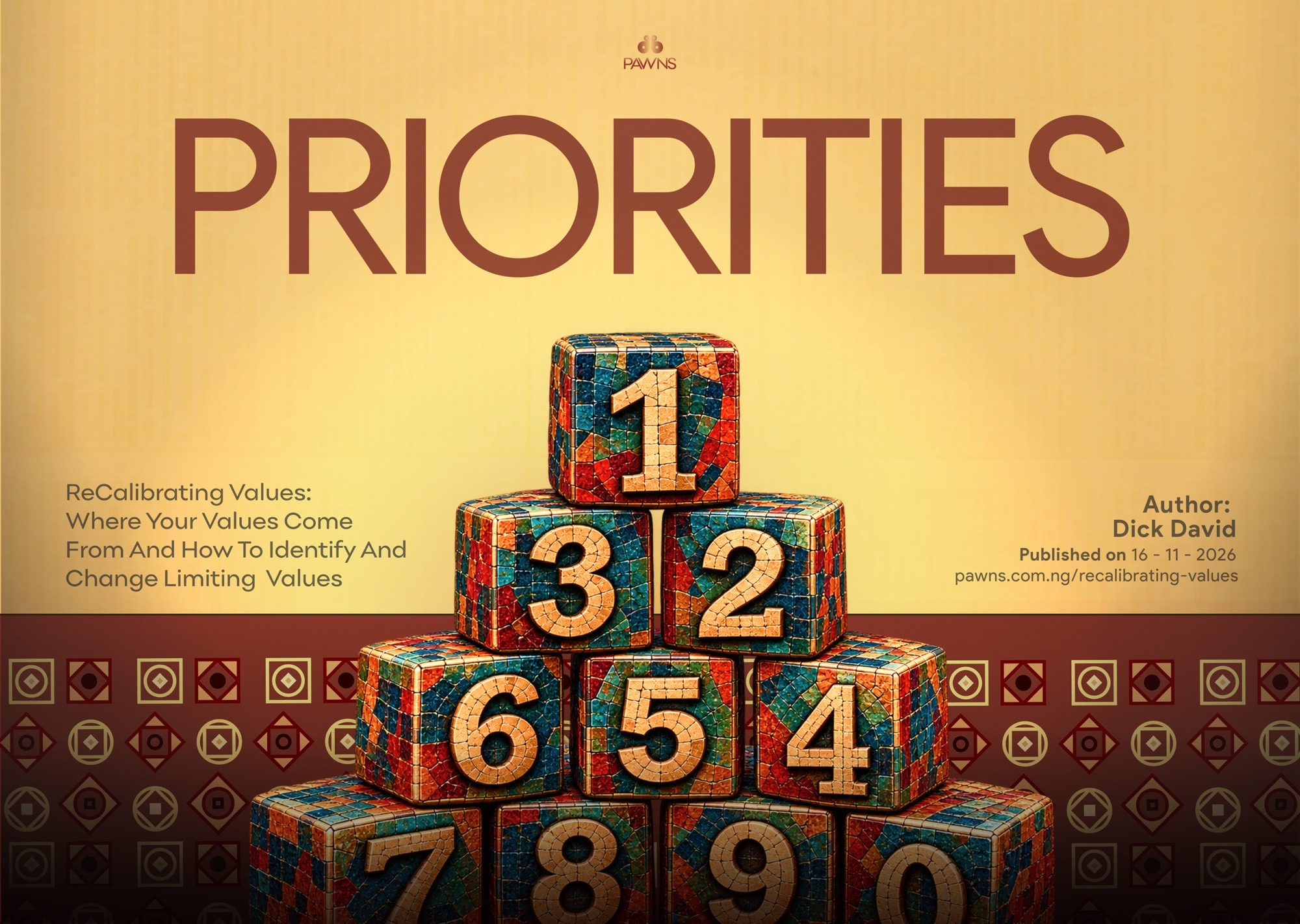
Consider the digits 0, 2, 1, 4, 6, 3, 5.
How do you think they should be organised?
To organise them, you have to have an assumption of what those numbers mean and what the goal is.
So if you believe they are numerical digits, then you may decide to organise them in ascending order, hence prioritising the smaller numbers: 0, 1, 2, 3, 4, 5, 6, or in descending order, hence prioritising the larger numbers: 6, 5, 4, 3, 2, 1, 0.
If someone says they want to arrange the numbers in ascending order, yet you find them putting 3 before 0, then you’d suspect something is wrong, right? Their order of priorities is wrong based on what they say they want to achieve.
Robert Greene, author of The 48 Laws of Power, often defines a fool as “Somebody who doesn’t have the right sense of priorities in life.”
Of course, in real life things are not always as simple as arranging numbers in ascending or descending order. For instance, you might be confused if someone arranged that same set of numbers as 2, 5, 4, 6, 3, 1, 0. You’d think it is nonsense. But that exact sequence might make perfect sense to them if they were considering the numbers as keys on an old mobile phone keypad layout, where their current order of the digits spells out the word “BLIND.”
Which is interesting, because often we are blind to what others truly value, and so we judge them with our own priorities, and then find fault in them. But even more troubling, sometimes we are blind to our own true values, and so we evaluate ourselves with societal values and find ourselves falling short of them.
These differences often cause rifts and strife, especially when interests or goals collide; and the more strongly we feel about those values, the greater the tension. This is part of the reason individual conflicts and full-blown wars may never cease to occur on earth.
For instance, imagine that there was another person who believes the numbers from our earlier thought experiment represented money to be paid to them. With that, it makes sense if they think 6,543,210 is the best possible way to arrange the numbers, as it results in the largest amount of money (six million, five hundred and forty-three thousand, two hundred and ten). And it also makes sense if they feel deeply upset or even lash out if you try to change the order of the numbers—because to them, any change is literally a loss of money.
Similarly, we feel strongly about our values, whether we are blind to them or not, whether we can articulate them or not. And a change in the order of how we see things might feel strange, uncomfortable, or even threatening.
For instance, the other day I was listening to someone speak while I was eating. It was nice hearing them speak, and I respected their opinion. But while they were speaking, we heard someone yelling that he saw a thief. This person who was speaking to me responded by saying, “Catch him; let us kill him.”
I was revolted by that statement and called them out — expressing my displeasure. I was so displeased that I literally struggled to finish my meal and stopped listening to them speak.
To me, whatever the young man stole can never come before his life. I value human life, his life, more than objects, even if it is money. If you remember the EndSARS protests, it was also because of this — even if every young man the SARS officers were killing had been a criminal (internet fraudsters and all), that would not make their lives any less valuable. And, I am glad we had enough people sharing that value to stir a nationwide protest.
Values In Groups
Values determine how we organise things in our lives, and how we organise things in our lives organises us into groups.
That is, people with similar/shared values gravitate towards each other.
For instance, if you have three presidential candidates: Candidate A prioritises winning, Candidate B prioritises fairness, while Candidate C prioritises qualifications. You will find that people who prioritise winning over fairness will lean towards Candidate A, those who prioritise fairness will lean towards B, and those who value qualifications will lean towards C.
Of course, there may be tension within groups – people who support Candidate A may not really like being unfair, but they can ignore rigging if that ensures winning is achieved. So also, those who value B may not really like losing, but they will sadly forgo winning if it ensures the process remains fair. The same with supporters of Candidate C, who may dislike losing and unfair play, but will tolerate both if it ensures the most qualified person leads.
For most people, facts and arguments don’t change their stance on this. They reject whatever tries to shake their order of priorities, because change often feels deeply uncomfortable and costly. This is doubly so if the value is held by a group they belong to.
Why?
Because there are real costs to change, no matter how little.
Sometimes it costs you victory and resources; other times it costs you your social standing or community. Trying to break away from some shared values can get you labelled a traitor and even attacked by those who still wish to organise things that way.
Pointing out to a Candidate A group member that there was rigging in the election will only get you the response, “At least our person won.” They won’t change their minds.
In Nigeria today, a lot of people vote based on qualification. The issue is, what they consider qualifications are often (old) age, (their) tribe, and (their) religion. And when you point out the issue with these yardsticks, again you hear them say things like, “Even though”, “Are you wiser than everyone”, “That is how it has always been done”, and so on.
As the social psychologist Leon Festinger put it: “A man with a conviction is a hard man to change.”
When evidence contradicts a core belief, it creates an extremely uncomfortable feeling called cognitive dissonance. And because it is so important to protect the core belief, people will rationalise, ignore and even deny anything that doesn’t fit in with it.
It is very, very hard to change people’s values, and you probably shouldn’t try. Your own values are tough enough for you to wrestle with.
Where Do Values Come From?
The late Charlie Munger, Warren Buffett’s longtime business partner, had a maxim he used to make judgments. The maxim goes: “Show me the incentive, and I’ll show you the outcome.”
It was a simple way of saying people don’t do things for no reason. That is, we organise things in a certain way because we get a certain reward for organising it that way.
To illustrate: Imagine you walk into a bank and see people in a single file. Perhaps there are velvet ropes by the side organising them.
Chances are you don’t need anyone to tell you what to do. You will simply organise yourself by standing behind the last person.
That is how everyone there believes things should be organised. And people organise themselves with that understanding.
If someone came and stood in front of you, you would be upset, because you don’t think that is how things should be organised. And if you complained, others would likely support you. In fact, if the person had cut in front of you just before you were going to head to the teller, the teller might ask them to wait for their turn.
But why?
We organise ourselves in queues because of the incentive of everyone being treated fairly, getting attended to based on when they arrived, and not having to waste energy fighting just to deposit and withdraw our money.
That’s a strong incentive.
But imagine there was a mother with a kid on that line.
The kid does not understand this organisation. They don’t understand why we stand in queues.
So what do they do?
They start running around; they go under the velvet rope, stand by the side, or in front of others, and the mother, all this while, keeps signalling, holding, and in some cases threatening to beat them if they keep running around.
Over time, the kid sort of learns to behave – as their parent punishes and rewards certain behaviours over time. They learn that when you come to the bank, when you see people standing in formation guided by the velvet ropes, you also stand in line. You organise yourself in that formation.
And by the time they are grown adults, they find themselves standing in long queues without needing to be informed.
They even organise themselves this way in open spaces, standing in line without velvet ropes.
That is practically how we inherit and organise most of our core values:
- Some of us grew up in families where obeying the instruction of the elderly was praised
- Some grew up in families where doing well academically was applauded
- Some grew up where dressing well and being neat was praised
On the societal level:
- Some of us grew up in societies where celibacy until after marriage was praised
- Some of us grew up in societies where forgiving and reconciling was praised
- Some grew up in societies where service and charity were praised
On the inverse, some grew up in families where lying, fighting or dirtiness were punished. And in societies where promiscuity, violence, or greed were punished.
Which is to say, the inverse of Charlie Munger’s maxim can also be true, in the sense that, “if you know the punishment, you can also predict the outcome.”
But aside from the praise and punishment, we also saw the results of our actions. We saw what obedience, academic excellence, and proper dressing brought. We also saw what promiscuity, malice, and greed do. And so we choose what we feel works.
But there are instances where unexpected things work.
I am talking about people who grew up in families where, when the younger one insults the elders, they are called outspoken and brave by the mother; when the mother lies to the father, she gets away with it as the man overlooks it; and when the father brings different women home, the mother responds by putting in more effort to please him.
In Nigerian societies today, it is common to see violent militants who killed countless people getting compensated with jobs and money, politicians who steal community allocations being prayed for and exalted with titles, and internet fraudsters who scam people getting rewarded with countless lovers and respect.
These incentives and punishments shape how the individual views life, and hence wishes to organise things.
Indeed, people can feel great internal conflict, but in the face of familial and societal pressure, they may choose what helps them survive — they may choose what works in the environment.
The Dual Nature of Values
It is a trap to view values strictly through the lens of “right” or “wrong”, “Good” or “Bad”.
Every value and every way of organising life has a rationale behind it — there is a reason people choose to organise things that way.
Indeed, there are times when defying authority, getting aggressive, or even stealing can be justified by the context. Think of VeryDarkMan dragging and insulting a prominent person online for saying or doing something wrong, a man defending his family by shooting at an armed robber who broke into his house, or a child from an impoverished family who steals food or medicine to save a sibling who is starving or deathly ill.
So there is often a tension between values. In the case of VeryDarkMan, respect and authority had to give way to truth and fairness; in the case of the man defending his family, care and love had to give way to safety and loyalty; and in the case of the child who stole, honesty and fairness had to give way to love and loyalty.
This applies to almost all values. Often, prioritising one means having to sacrifice or compromise another. This is because values can compete for the same resources or demand different courses of action.
Drawing on the works of psychologist Jonathan Haidt (on moral foundations) and Shalom Schwartz (on basic human values), here are some everyday examples to illustrate how competing values create tension within:
- Care vs. Achievement: Pursuing personal success and advancement can sometimes compete with caring for others and prioritising their wellbeing. You want to “japa” or take a demanding job in a far city to build your career, and you also want to take care of your ageing parents back home. Tension happens when a massive career opportunity requires you to move far away, leaving nobody at home to look after them personally.
- Fairness vs. Power: Pursuing dominance, privilege, or personal advantage can sometimes conflict with treating everyone equally and fairly. You strongly believe that everyone should follow the same rules and wait their turn, and you also enjoy the status and VIP privileges that come with being an “oga” or “big man.” Tension happens when you arrive at a long bank queue, an airport check-in, or a busy event, and you have to choose between waiting patiently like everyone else or using your status and connections to skip the line.
- Loyalty vs. Universalism: Prioritising one’s immediate community, family, or group can sometimes conflict with extending equal concern and consideration to everyone. You are deeply loyal to your family, village, or ethnic group, and you also believe every Nigerian should be treated equally. Tension happens when a position opens up in your office or community, and you feel pressured to favour your “brother” over a more deserving candidate from another background.
- Authority vs. Self-Direction: Respecting established rules, traditions, and hierarchies can sometimes conflict with independent thinking and the courage to question the status quo. You genuinely respect your elders, parents, and religious leaders, and you also want the freedom to live life on your own terms. Tension happens when your parents insist you study Medicine or Law, or marry someone from your hometown, while your heart is set on a different career or partner.
- Liberty vs. Security: Protecting individual freedom and autonomy can sometimes conflict with maintaining collective safety, stability, and order. You love moving around freely and running your hustle without interference, and you also want your street to be completely safe from armed robbers or cultists. Tension happens when your estate association or local government enforces strict gate closures by 10:00 PM, limiting your freedom to come home late.
Indeed, you can genuinely care about two opposite things at the same time, and feeling torn between them is a normal part of life rather than a flaw in your character.
Feeling conflicted does not mean you are confused or hypocritical. It simply means you hold multiple valid priorities, and life is asking you which one to prioritise right now.
This, of course, requires wisdom — an ability to find the right balance between these competing values. And that’s a huge topic on its own, which we can’t cover here.
But what we can do is help you examine the current values you hold to know if they are even worth the tension.
How Do You Decide What Value To Choose?
In the book The Subtle Art of Not Giving a F*ck, Mark Manson highlighted that it is best to choose values that are:
- reality-based,
- socially constructive,
- immediate, and controllable,
while forgoing values that are:
- external,
- emotionally reactive, and
- destructive to long-term growth.
I agree with him.
Using this rule of thumb, let’s contrast similar values people often hold in our society to see which are stronger or worth holding on to and those that are weaker and ought to be let go:
Evidence-based vs emotionally reactive
Imagine two people hold the value of cleanliness. One looks to achieve this through religious purity, which often runs on feelings like shame and fear. The other looks to achieve it through scientific hygiene, which runs on knowledge and evidence.
In terms of achieving the desired goal, the emotional approach would mostly be hit and miss, because it goes by what is believed to be clean, not necessarily what is clean. Some religious practices might even worsen the situation. For instance, when many people are immersed in the same untreated water, such as a crowded holy pool or a polluted sacred river during a festival, the ritual meant to purify can end up spreading skin infections, eye diseases, and parasites. While the evidence-based approach will actually hit the mark, because the pathogens are actually understood and eradicated. For instance, people go to take their baths in a treated running shower. The interesting thing is that some religious practices now strictly emphasise the use of flowing water and modern sanitation to prevent contamination.
Worse, religious purity dogmas can laden people with shame, treat physical sickness as a moral failure, and turn vulnerable people into social outcasts. Overall, values intended for cleanliness end up becoming limiting and even catastrophic for both the individual and society as a whole, even though the goal was noble.
So you must ask yourself why you hold a value. Are you holding on to it because of how it makes you feel, or because of what the evidence says works best today?
Socially constructive vs socially destructive in the long run
Think of two people who value progress, but one holds the value of mastery and reciprocity while the other chooses winning and dominance.
While winning often leads to personal progress, it often also permits predatory and exploitative behaviours. We are talking about things like fraud, blackmail, or embezzlement, which erode the fabric of society. Aside from it being hard to trust anyone in a society riddled with criminal activities, the economy also gets stifled as fewer people do anything productive, even if they may have cash in surplus.
This isn’t just theoretical; countries such as Albania, Somalia, and Guinea-Bissau have experienced this. Most recently, in 2026, Haiti is facing one of the world’s most severe humanitarian and economic crises, among the worst the country has seen since the 2010 earthquake. Why? Armed gangs took control of roughly 90% of the capital, and instead of farming and building infrastructure, they kept running massive kidnapping, extortion, and port rackets that generate tens of millions of dollars annually. And while the gang members and corrupt elites were making a lot of money, their activities essentially strangled legitimate commerce, which pushed the nation into a multi-year economic depression and left over half the population, about 5.8 million people, facing acute hunger. In Nigeria today, internet fraudsters and bandits are doing the same; they are making a lot of money without adding anything meaningful to society.
On the other hand, mastery and reciprocity are constructive. They are scalable because they add value to society and build trust. That makes them positive-sum: the more people hold them, the better off everyone is. This is how countries like China, Japan, South Korea, and Singapore, which were once poor or war-ravaged, were able to turn their fate around by pushing education, vocational training, and a culture that rewards people for their labour. Recently, there was news of a former Chinese official, Yang Youlin, who was sentenced to death in July for taking over 2.2 billion yuan (about $325 million) in bribes and other offences between 1993 and 2023. Whatever you think of the punishment, it shows how seriously that state treats their values.
So you must ask yourself: is this value just serving my inner circle and me? Is it something I am okay with everyone holding? What will it cost us in ten years? And is it adding something positive to the world?
Immediate and controllable vs external
Think of two people who prioritise respect and standing, but one values integrity while the other values reputation.
While you can successfully build reputation and hence respect, it is external, which makes it fragile. All it takes to lose it is one mistake, rumour, misunderstanding, or setback. Reputation lives in other people’s heads. Integrity lives in your own hands.
For your integrity, it doesn’t matter what happens. You always know you can keep your promise to yourself and others, and even when you fall short, you can do something about it right away. It is immediate and within your control.
So ask yourself: are you trying to make sure everyone likes you, instead of standing firm in your own boundaries?
Overview of how to choose values
| Strong/Empowering Values (Worth keeping) | Weak/Limiting Values (Worth letting go) |
| Evidence-based | Emotionally reactive |
| Socially constructive | Socially destructive |
| Immediate and controllable | External |
Now that you know what makes a value worth holding onto or letting go, how do you actually change your values?
How To Change Your Values
Most people don’t change their values until their values fail them.
And values often fail when they are tested outside the environment they were formed in.
And this is exactly why most people don’t change, as they remain more or less in the environment that shaped them.
Our core values constitute a great deal of our identity; so modifying, letting go of, or adding a new value feels like torture, death, or rebirth.
If you don’t want to wait to find yourself in an environment that forces your values to fail, then you must brute-force them to break.
To do this, you have to embrace one of these things, some more uncomfortable than others:
- Cognitive dissonance
- Confrontation
- Trauma and tragedy
- Education
- A new environment
To see how each of these works, let’s follow a single student through all five.
Cognitive Dissonance
This is a very powerful and uncomfortable feeling that comes up when what you say and what you do are not in alignment.
For example, if a student says they value honesty, but during an exam the invigilator gets distracted, and they copy from the person next to them, their heart might begin to probe them on why they did that.
That internal conflict can get so loud in some students that they stop cheating, hence sticking to their value of honesty.
But there are students who, in order to resolve the conflict, would tell themselves that they did it because the time was too short, the course was too hard, or that they couldn’t risk having an extra year. If they continue doing this, with time they may come to plainly accept winning over honesty in certain situations, essentially relegating honesty to the back in such situations.
Notice the order: the behaviour came first, and the value got modified. This is why you must be carefully what you rehearse.
Many students do this all through their stay in school, and by the time they graduate, it feels right to lie on their CV and so on.
In these ways, cognitive dissonance becomes a gateway for reshaping values for better or worse. The same mechanism can cement honesty or dishonesty.
Cognitive dissonance, however, is only as powerful as the self-awareness of the individual.
And since many people can walk around unaware of the conflicting beliefs they hold, they often need to be confronted.
Confrontation
Confrontation is a deliberate attempt to unearth the contradictions between what we profess as our values and what we act out. This can be done by ourselves, or by someone else.
For instance, if a student says they value honesty, but copied in the last two exams because they believed the course was too hard, then by sitting down to think about that, or even journaling about it, they can see that clash staring them in the face.
However, because it is so difficult for many people to sit with their thoughts or even write them out in a journal, it comes in handy to have someone to remind you of what you said you value and how your current actions contradict it. Say a friend who witnessed the event, and then asks you, “Didn’t you say cheating was wrong? So why cheat in the exams?”
Sadly, many people don’t get the luxury of an honest friend or a professional therapist. In fact, the friends they do have may be the very ones copying alongside them. So such people often learn the hard way, when they experience trauma and tragedy.
Trauma and Tragedy
While no one prays for painful events, they often prove to be exceptionally powerful in recalibrating values.
For instance, if a student who has been cheating because they couldn’t risk having an extra year gets caught and expelled, and is then distanced by the very people they thought were their own, this might force them to start questioning that value altogether. And when the disciplinary panel finally spells out, in plain terms, what it has cost them, it may break their value of winning at all costs and force them to think more about honesty and competence.
Trauma and tragedy feel palpable and particularly painful, unlike cognitive dissonance, which is mental, or confrontation, which is friendly. They violently nudge us away from autopilot and passivity.
They break everything down, as we are defeated, so that we may rebuild, a process rightfully called “positive disintegration,” a term from the Polish psychiatrist Kazimierz Dąbrowski.
It makes us dig deep and examine how we’ve been living: how we’ve been organising things in our lives, and what things are really important and why they are important.
However, like the other mechanisms, it is only a doorway which can lead to both good and bad values. For instance, some expelled students conclude that cheating is only wrong when you get caught, and become more careful, more cunning, and more ruthless about winning. Others become fiercely honest and justice-driven, speaking up whenever they see others cheating.
But, of course, you don’t have to face trauma and tragedy to decide on what values are worth holding on to or which should be let go. You can always change through cultivating awareness and educating yourself.
Education and Awareness
Sometimes learning new information triggers a feeling of cognitive dissonance, which forces us to see the misalignment between our knowledge and our behaviour, shifting what we value.
Other times, we can live through confrontations and trauma vicariously through other people’s stories. A student who hears how a senior in their department lost their degree over a single case of exam malpractice, and how the friends who copied alongside them disappeared, may begin to rethink their own habits without having lost anything themselves.
Very good stories sometimes throw you into other people’s shoes and hypothetical situations, forcing you to see which values you lean toward. They then take you on a journey, showing you what response is best so you can prepare beforehand—even if, in reality, things may not get as brutal as they do in the story.
While it may be tedious to read, listen, and learn, this is perhaps the most pleasant of all the mechanisms for changing our values.
Nevertheless, since values often depend on context, are shaped by consequences and rewards, and are sustained by the urge to belong, the most thorough way to sieve through and recalibrate our values is to put ourselves in entirely new environments.
A New Environment
Remember, values often fail when they are tested outside the environment they were formed in. So one of the quickest ways to test yours is to change your environment.
A change of environment often means a change of peers, goals, and the reward-and-punishment mechanisms around you. For some students, this means transferring to a different institution. For others, it means distancing themselves from the friends in their circle who copy together, while finding those who study together. In the old circle, copying might earn the name “sharp” while honesty earns the name “dull”. In the new one, it may be the other way round.
Overall, the trick here is to be around people who generally organise things differently, so that they show you how to do the same—say, how to revise so well that the panic never comes—and call you out when you misplace your priorities.
It is good practice to occasionally spend time in a culture or community outside your own. Sometimes, you get to discover new ways of doing things—or see the ways in which your old habits have been hamstringing the life you wanted.
And like the rest of the mechanisms for change, it also comes with costs—be it travelling fees, distance, loneliness, or simply being the odd one out in a new environment.
Conclusion: There are no good or bad people—just different values
“Good people.” “Bad people.”
These are descriptions we use for real people.
Yet they are not objective or metaphysical truths. There are no good or bad people—just the values they hold, which lead them to behave in ways that are either helpful or unhelpful.
Still, we label people as good or bad because it helps us make sense of ourselves and the people around us. And that understanding helps us more effectively navigate—and even improve—our societies.
The work, then, becomes thinking deeply about why we value certain things, and having the courage to confront the ones that do not serve us.
That is how we moved away from a world where enslaved people were killed and buried with their masters, and toward a society where, at least in principle, no one is owned or sacrificed for a burial rite.
And that is how we can still move toward the society we dream of—a society that better supports the flourishing of individuals.


Dick David is a freelance SEO content writer and editor with over 7 years of experience in content writing, digital marketing, and sales. He is the founder of Pawns Digital Agency. Throughout his career, he has authored over 4 books, published hundreds of SEO articles attracting thousands of monthly visitors, ghostwritten numerous works, and edited hundreds of content pieces across various industries. Currently, he works with Robert Taylor Media and has also worked with Tobi Digitals and Branditechture Design Agency, among others.