


From relationships to career, the need to make the right decisions can be overwhelming. But much of the difficulty comes down to how we approach them.
There’s a story about Plato and Socrates that captures this.
In the story, Plato asks Socrates, “What is love?”
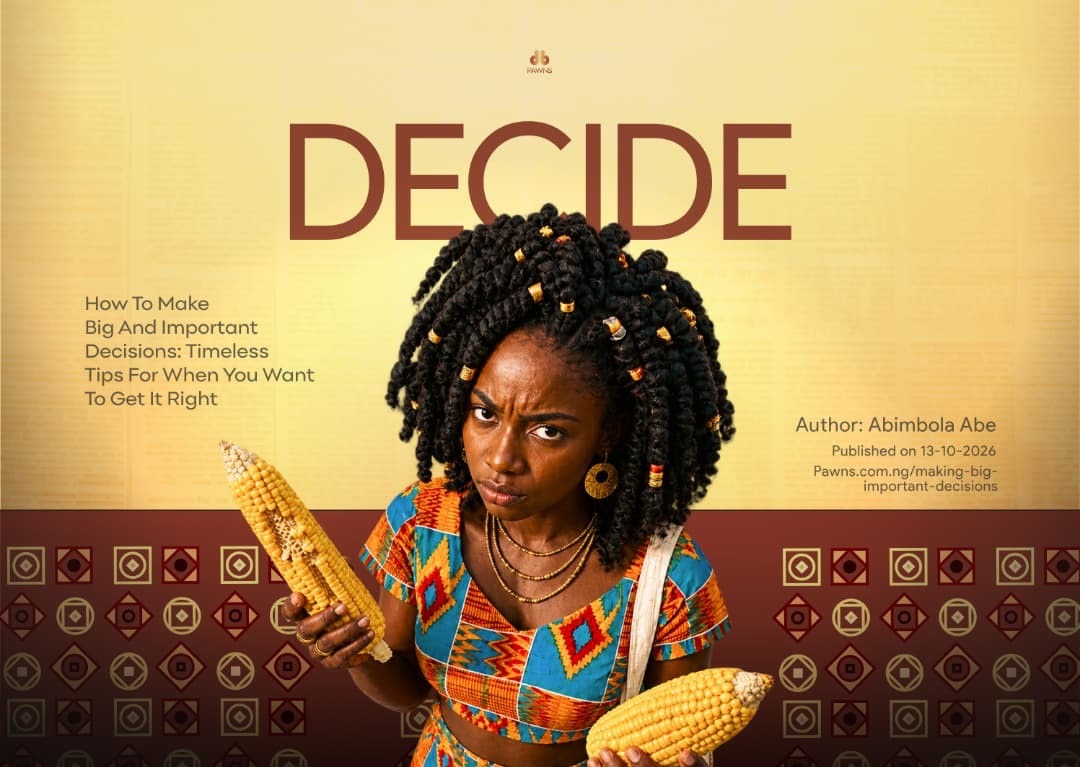
Socrates seems to ignore the question and instead sends him into a cornfield. “Bring me the biggest ear of corn you can find. But you can’t turn back once you’ve walked past an ear of corn.”
Plato walks in and almost immediately sees a big, juicy one. But he thinks there’s probably a bigger one ahead. He walks on. Another good one. Same thought. He walks on. Then, slowly, the corn starts getting smaller. And it dawns on him that the best ones are behind him now, and he can’t go back.
He returns with nothing.
“That,” says Socrates, “is love.”
Curious, Plato asks, “Then what is marriage?”
Socrates ignores his question again, and sends him back into the field with the same rule. This time, Plato doesn’t go looking for the biggest ear of corn. Somewhere in the middle of the field, he finds one that is healthy and big enough for him, and he decides it will do. He picks it and walks out.
“That,” says Socrates, “is marriage.”
The story might be fictional, but the message is clear: It is easier to make a decision if you know what is good enough for you.
Why Making Decisions Feels So Hard (And Why More Options Don’t Help)
We like to believe that more options lead to better choices, and that more research will make us more certain. But this is not true.
I have spent whole weekend nights searching for the best movie to watch on Netflix, only to get overwhelmed and end up asking a friend for a recommendation, or just letting the app pick for me.
This is what psychologists call decision paralysis, or analysis paralysis, and one of its biggest causes is having too many options.
In one experiment, researchers Sheena Iyengar and Mark Lepper set up a jam-tasting table in a supermarket, offering either 24 flavours or just 6. The bigger table drew more people, but the smaller one sold far more jam. With too many jars to choose from, most shoppers walked away empty-handed.
Decision paralysis is even worse when the options are hard to compare, when you’re unsure what you want, and when the stakes feel high.
For example, a while ago, I was torn between going all in on AI and ignoring it. Everyone on my feed was suddenly an AI expert. As a marketer, I kept wondering whether I should rebuild how I work around these tools or just keep doing what I knew. What if I leaned in and the hype faded? What if I didn’t and got left behind?
There were a hundred tools, courses, and opinions, and every week someone new on LinkedIn was telling me this was the one to learn. The more doors I saw, the less ready I felt to walk through any of them.
Dating apps work the same way. When you can keep swiping forever, it always feels like someone better might be one swipe away, and that makes it harder to give anyone a real chance.
The Five-Stall Theory: A Simple Decision-Making Process
When I was much younger, my mom used to carry me along to the market. She would walk past four or five stalls selling the same thing. At every one, she’d stop, ask the price, and haggle. Only then would she go back and buy.
I found it exhausting. Sometimes, after all that walking, she’d buy from the very first seller, who had been the cheapest all along. So why didn’t we just buy it there?
It took me years to understand that she was never after the perfect price; she was after a baseline. Those first few stalls told her what the thing was really worth that day. Once she knew that, she could recognise a good deal on sight, and pay without wondering whether she’d been cheated.
I call it the Five-Stall Theory:
Look at enough options to learn what “good” looks like. Then take the first one that meets that standard.
The psychologist Barry Schwartz sorted decision-makers into two types: satisficers and maximizers
Satisficers know roughly what they need and take the first option that meets it. Maximizers need the best option, so they keep searching and comparing to be sure.
I am a maximizer, as you’ve probably guessed.
In Schwartz’s research, maximizers reported more regret and less satisfaction with life. And in one study of graduating students, maximizers landed jobs paying about 20% more, yet felt worse about them.
So maximizing can win you a better result and still take the joy out of it. The real question, then, is when to stop searching.
I think my mom’s approach is the way. The maximizer searches to get rid of doubt, so the search never ends. Satisficers often set their bar low, so they may settle for less than they could have. My mom, on the other hand, searched to sharpen her judgment and find out what she really deserved, so she knew exactly when she found it.
The 37% Rule: How to Make Better Decisions
Interestingly, the cornfield dilemma is something mathematicians have actually studied. They call it the optimal stopping problem.
Say you’re hiring for one role. Candidates arrive one at a time. After each interview, you hire them on the spot or lose them forever. How do you give yourself the best shot at the best person?
The answer is oddly precise. Spend the first 37% of your search just looking, without hiring anyone. Then pick the first candidate who beats everyone you’ve seen so far.
Look at that first 37% again. It’s basically my mum’s first few stalls: you aren’t choosing yet, only learning what good looks like. After that, you commit to the first option that clears the bar instead of walking on.
This doesn’t mean you should date 37% of the people you’ll ever meet and marry the next one who beats them all. Real life breaks almost every rule of the puzzle. You rarely know how many options are coming. Sometimes you can go back.
And unlike the cornfield, real life doesn’t stand still. The options keep changing, so sometimes the best you can do is choose well now and be willing to choose again later.
How to Stop Overthinking a Decision After You’ve Made It
Making a decision is only half the work. The other half is living with all the options you didn’t pick.
After weighing the pros and cons of leaning into AI, I decided to go all in. Today I use generative AI every day to do my marketing work faster. But the worry never fully went away. The tools change every few months, and part of me still wonders whether the skills I’ve spent years building will matter in five years.
This worry shows up in other aspects of life too. After a fight with your partner, your mind might keep flashing back to that one person you didn’t date, the one you’re sure would never have said what your partner just said. The hard part is that you never get to try the options you passed on. So we see every one of our partner’s flaws, while the person we didn’t date stays flawless in our head. The same happens with jobs: the one we took has bad days, and the one we turned down still looks perfect.
The best thing you can do after making a decision is to close the door on the options you didn’t pick. In one study, people who were told they couldn’t swap the photo they picked ended up liking it more than people who were allowed to swap it later.
Closing the door is scary, because it leaves room for regret. But regret isn’t always a bad thing. It can be useful if we turn it into reflection and ask, “What can I learn from this?” instead of “What if I had chosen differently?” If you keep asking the second question, you’ll never get an answer.
How Do You Know You Made the Right Decision?
The truth is, sometimes we do choose wrongly. And if a job or relationship turns out to be toxic, staying isn’t commitment. It’s settling.
So how do you know the difference?
First, separate a bad decision from a bad outcome. A decision is good if it made sense given what you knew and valued at the time. Outcomes depend on luck, timing, and things nobody could see coming.
Instead of asking “Did I choose right?”, ask “Did it make sense with what I knew at the time?” If the answer is yes, stop blaming yourself.
Change your mind only when something real changes. For instance, if
- you learn something important you didn’t know before.
- your values or circumstances change in a way that makes you rethink your choice.
- the choice is causing real harm, not just normal difficulty.
- one of your non-negotiables is broken.
Settling is when you stop looking because you’re tired. Committing is when you stop looking because you’ve found something worth keeping.
Conclusion: You Can’t Always Pick the Best Decision, But You Can Make It a Good One
When I started writing this, I thought contentment was something you find. Pick the right corn, and you’ll be happy. Pick the wrong one, and you won’t.
I don’t believe that anymore. I now think contentment is partly found and partly built.
I’m still a maximizer. I still research and compare and ask everyone I know before I make a big call. But I’ve started to accept that certainty isn’t coming, whether it’s about my career, my relationships, or where I’ll be in ten years.
So what do I owe the life I chose? I think I owe it a fair chance. Enough looking to know what good looks like, and then the patience to let what I chose grow into something, without holding it up against a version of my life that only exists in my head. And if it truly isn’t working, I owe it the honesty to say so and choose again.
I started this article asking whether I was making the best decision. I still can’t answer that, and I don’t think anyone can. But whatever I choose, I can make it a good one.
***
Did you find this piece insightful? Please drop a comment and share with friends and family.
Below are some other pieces you might like:
- Tired of Saying Yes to Everything? Here’s How to Say No (Without Guilt)
- 3 Strategies For Making Decisions When You Don’t Have All The Information
- How Good Values Lead to Bad Actions: Doing Right When It’s Hard to Do
- Confident Ignorance: The Power of Admitting That You Don’t Know.
- The Identity Trap: Why Your Success Might Be Holding You Back (And How to Break Free)

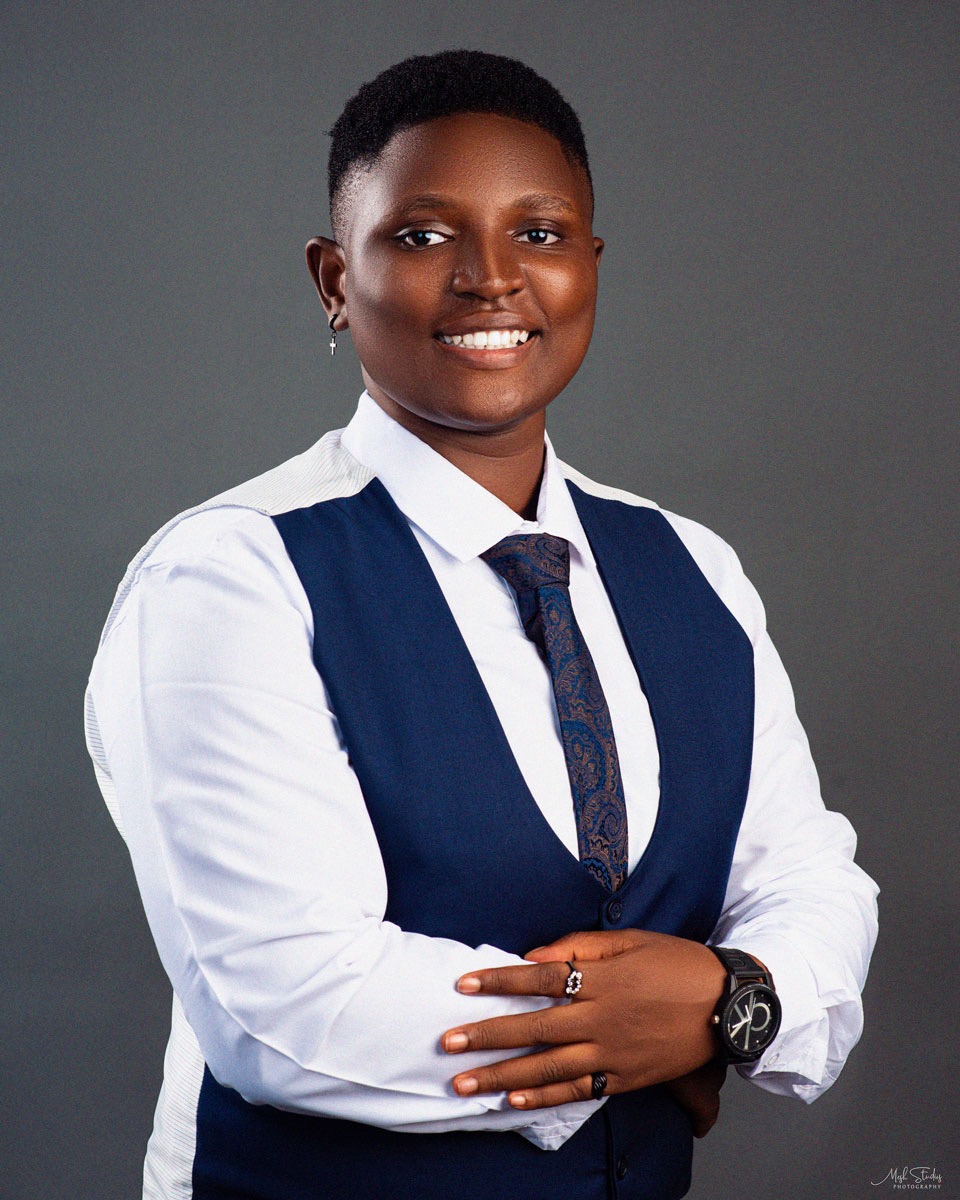
Abimbola Abe is the co-founder of Launchstack, a marketing and automation agency. She is a writer and thinker passionate about self-development, philosophy, and the way we experience life.
Beyond writing, she trains individuals and businesses on leveraging AI to improve productivity and streamline operations. Through her work, she helps people and brands work smarter, grow faster, and navigate the evolving digital landscape more effectively.