


You know, there are people who not only endure, but are prolific at jumping from one toxic relationship to the next. People who endure insults, cheating, and even being beaten. But what the hell is wrong with us who have not been able to get into and stay in a relationship for the past 3, 5, 10+ years?
It’s easy to look at those who can’t seem to be alone, who endure the worst relationships, as having serious issues related to boundaries, self-worth, or self-respect. But what explains why we are chronically single? Is it fear, shame, lust, analysis paralysis, personality disorder, or some other elusive milestone we are yet to attain?
I, for one, have always feared that no lady would choose to stay with me if I couldn’t take care of her financially. For the longest time, that sounded like a legit excuse. In fact, it is still my knee-jerk answer when someone asks, “Why are you single?” But I have learnt to catch myself before saying it, because it isn’t really true.
Poor people do date, and I don’t consider myself poor. I have seen relationships where the lady provides more. And, in other cases, no one takes on the responsibility of providing for the other – they simply enjoy the relationship, sharing life together, while standing on their own feet.
So, is it pride? Is it that I don’t want to date until I can afford to go on expensive dates and take vacations to exotic places where we can take cool pictures to post online?
Or, perhaps, is it that I don’t really think the ladies I have met so far tick all my boxes, and if I wait a little longer and hopefully rise a little higher financially, I will be able to attract those Instagram baddies?
Maybe.
Maybe too many rap songs, Hollywood movies, and social media posts have skewed my understanding of what a relationship should look like.
What Really Holds Us Back
A few days ago, a friend asked me what I think men look for in a lady they want to marry. I told her it depends on who you ask. So she asked what I was looking for.
Without hesitation, I made my list:
- Shared values
- Intelligence
- Care
- Respect (adoration)
- Beauty
- Skill/hard work
I didn’t even look up the chat with her while writing this. I pulled it out of my head in the same order I gave it to her, because it is what I constantly evaluate ladies by.
But then it hit me. All the ladies I have been hovering around, talking with but never committing to, even when they made it evidently clear they wanted to date me, had all these qualities to some degree.
Lady A has like 60% shared values, 75% intelligence, 30% care, 60% adoration for me, 50% beauty, 90% skill and hard work.
Lady B has like 40% shared values, 50% intelligence, 90% care, 80% adoration for me, 60% beauty, 50% skill and hard work.
Lady C has like 50% shared values, 60% intelligence, 25% care, 50% adoration for me, 90% beauty, 60% skill and hard work.
All of these ladies are good enough to date. I only have to choose.
But I hesitate – I freeze when things start getting serious.
Why?
Because, deep down, I know to choose is to also sacrifice.
The one with little care but much beauty might leave me missing the care of the one who adores me. And the intelligence of the one who isn’t as beautiful might leave me missing the beauty of the one who doesn’t stimulate me intellectually.
But this isn’t a flaw on the ladies’ part.
No single human can score 100, or even 80, across all of these. Not even I score that high on those metrics. I am not 90% handsome, and my values often fall below 30% when compared with what the average Nigerian lady might expect, such as love for God, culture, or greatness.
If anything, putting these ladies on a spreadsheet (trying to maximise, as psychologist Barry Schwartz calls it) reflects my own indecisiveness: my inability to decide what matters most to me and what is worth sacrificing, and a faulty mindset that doesn’t fully believe in the growth potential within a relationship.
And it is silly because, even now that I am single, I have not died from those needs going unmet.
So, is the problem really with the ladies?
I don’t think so.
Deep down, people like you and I have no intention to hurt or disrespect these ladies by comparing them to others. Rather, we struggle with an approach-avoidance conflict: we want closeness, yet dread it when it comes.
We dread it for many reasons, some of which are hard to shake. Some of us are uncomfortable with our imperfections being seen, fearing we would be judged as inadequate and flawed. We fear the relationship might restrict our freedom and drain us. We recoil when we remember the last heartbreak we had and how long it took to heal. For many of us, it is a mix of all these. Not to mention childhood experiences and societal expectations.
So we turn the judgment outwards, seeing their imperfections as flaws and their uniqueness as inadequacies.
But imperfections and uniqueness are not flaws and inadequacies in reality, as we have feared. We simply learnt to see them that way.
And until we unlearn that, we will keep disqualifying – ourselves and then them.
That’s the reason we get a strong crush on someone, then watch it fade within days as we get to know them better and slot them onto our mental spreadsheet. It’s the reason we keep contact with these ladies, enjoying the feeling of being wanted without going all in.
And it is a problem.
What Do We Actually Want?
The reality is that the long list of wants is only a filter for what we don’t want.
And the filters break on even a “perfect” lady, given the right (or wrong) circumstances.
How?
The caring lady might one day be too enraged to care, and even hurt us with her words or actions. Does that end it?
The intelligent lady might be oblivious to a certain subject, or simply not care about it. Does that end it?
The beautiful lady will grow old, or, God forbid, might suffer a terrible facial injury. Does that end it?
We could go on and on.
But the question is: what do we really want when our preferences change?
Or is it that we care more about how they make us feel than about simply liking them for who they are?
Is that why we are so quick to take yet another lady’s number, go on yet another date, and ask for another round of sex? Because those are the things we really want, and not the ladies themselves?
Why Should We Decide?
I didn’t really get why (we should decide on who to date and marry) until I saw a picture of a pregnant lady. She looked like a lady I had a crush on way back in university. And in that moment, I realised that what I would really love is to have a child with a lady I care about (a desire psychoanalyst Erik Erikson called generativity).
Yes, what I want is to share my life with someone: to build a family, finances and experiences with them. It was never about them being perfect or meeting some standard.
Perhaps you want that too.
By this, the choice of commitment becomes about choosing something beyond the person we see.
It becomes about what we want to build together.
It becomes about the future.
While things like shared values, intelligence and hard work might come in handy, they can be negotiated and worked with as they are to build that future.
And, if we are playing the long game, we don’t really need the absolute best person. We just need someone who is dedicated and focused on that future.
And that is why shared vision is critical.
Whose Flavour of Struggle Are You Choosing?
Commitment is a decision, not a discovery. And struggle afterwards doesn’t prove a wrong choice. It only proves you decided on the struggle.
So, perhaps, when deciding who to date, the question should be: whose struggle are you willing to endure?
Not deciding is still a choice, and it comes with its own set of struggles. Else I wouldn’t be writing this, and neither would you be reading it. If drifting through lovers were perfect, we wouldn’t care about choosing a partner.
Of course, this is not to say that those who endure abuse in relationships are right to stay, or that we should all do the same. No.
There is a clear difference between struggling to achieve something and suffering at the expense of what we want to achieve. One is simply slow. The other is regressing.
Think of it like lifting a couch. You need two people. One may be stronger than the other and have to pause from time to time, letting the other rest. In a toxic relationship, the other person doesn’t just abandon the couch for you to carry alone. They might even sit on it, making progress impossible.
So when we talk about struggle, picture a partner who is clumsy with the couch but brilliant at helping you paint, tidy, and decorate the house.
Which brings us back to the idea of being clear on what we really want out of a relationship. For me, at the moment, it is:
- An accountability partner
- A mental sparring partner
- Emotional support
- Financial support
- A buddy to share experiences with
And in the long run:
- A child or two
- A present mother for the kids
- Someone to care when I fall sick or face a major life crisis
- Someone to stay friends with as I age
- Someone to take care of the kids and assets when I die
That said, all that is left is choosing someone who meets what is most important to us, and with whom we can endure the struggle for the rest.
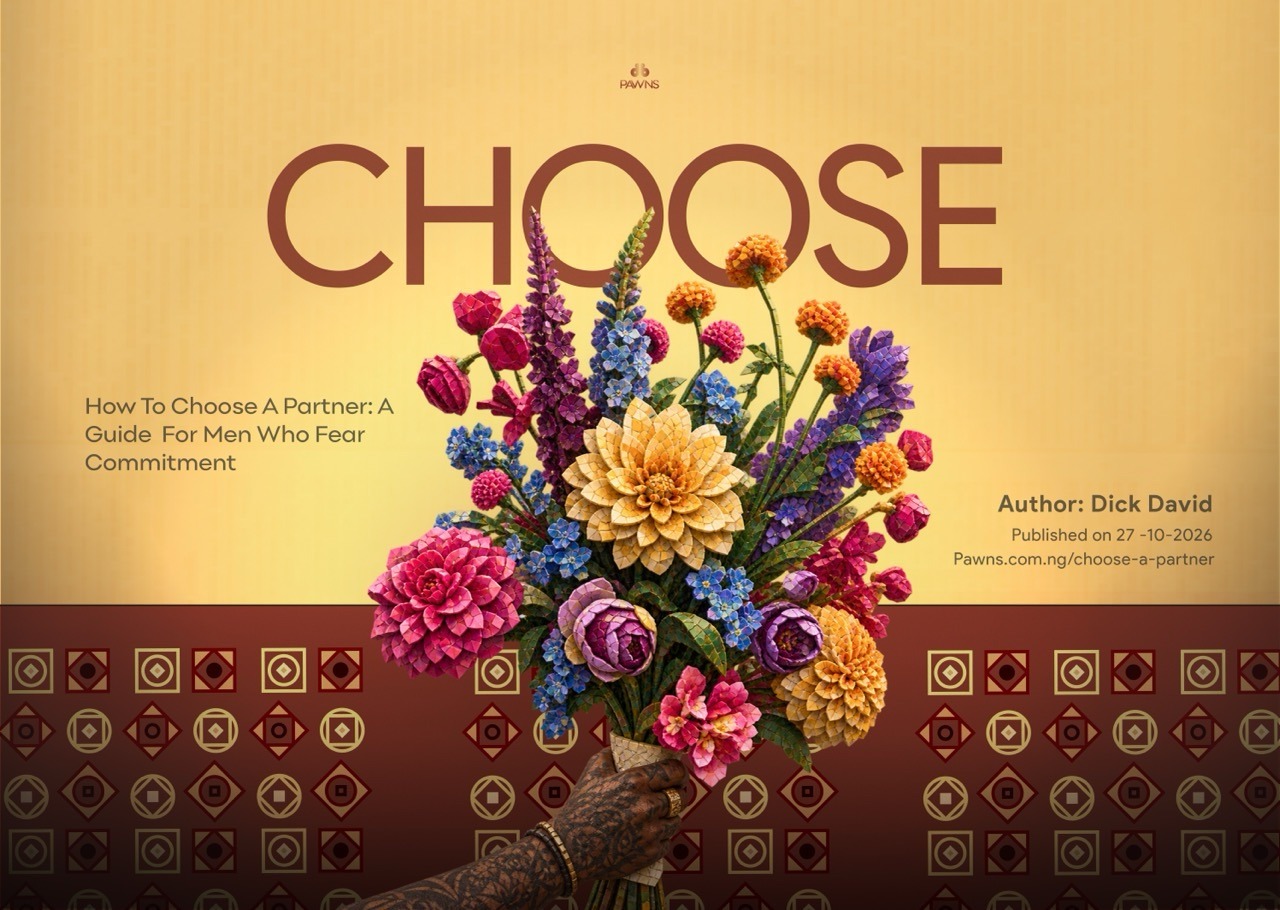
Conclusion: Choose Who Is Already Building The Future You Want
In a podcast, Mel Robbins asked James J. Sexton (who is a divorce lawyer and family law attorney) what he wished every couple understood before getting married. And he said it was two things: The first is believing that marriage will change your partner, and the second is believing your partner will not change after marriage.
It sounds like a contradiction at first, but it isn’t. His point, as I understood it, was that it is silly to think the person who never texts first, never reads, or never enjoys working will spontaneously start texting, reading and working hard once we marry them. On the other hand, it is also silly to think the person who shares plenty of values with us, who is very beautiful and who adores us so much will not one day have a new set of values, grow less physically attractive, or shift some of that adoration from us to the kids.
And while that seems like another reason to spiral into endless deliberation about whether getting into a relationship is worth it, I think the message is quite clear. Have realistic expectations, and plan ahead. Understand that a real relationship will require regular negotiations, effort, and compromises. What matters most is not the initial choice, but how well you handle the relationship.
Which is to say, even a perfect choice is not a guarantee. But an okay choice with enough effort can endure.
Maybe this piece has even given you more metrics to measure the next lady you meet by. I understand. But we must also understand that most of our reasons for holding back are simply excuses.
The secret then becomes to find someone who wants similar things to us, and then work with them to build it out.
As Mark Manson once said, “Soulmates are built, not found.”
Indeed, if we are intentional about our lives, chances are we are already working on our career, cultivating good habits, and recalibrating our values, even if we are stuck or struggling. Similarly, a good partner is also working on their career, cultivating good habits, and recalibrating their values for the future.
So, why not just choose someone who is already building?
I’m sure someone came to mind.
Why don’t we ask them out today?
And when they ask why we want to date or marry them, we tell them exactly the future we envision with them.
***
Enjoyed reading this? Leave a comment and share with friends and family.
Below are some other content you might like:
- You May Never Date Your Crush, But Here’s How to Land a 10/10 (The Stable Marriage Problem)
- How to Ask Her to Be Your Girlfriend (Without Scaring Her Or Risking Embarrassment)
- Standards Vs. Expectations In Relationships: The Key To Avoiding Disappointments and Toxicity
- 10 Things You Can Expect From A Relationship
- Chronically Single: 10 Reasons You Might Still Be Single [And What You Could Do About It]
- [Good & Bad] Reasons to be in a relationship with someone
- How to Get a Girlfriend: 10 Steps Guide To Finding The Right Girl


Dick David is a freelance SEO content writer and editor with over 7 years of experience in content writing, digital marketing, and sales. He is the founder of Pawns Digital Agency. Throughout his career, he has authored over 4 books, published hundreds of SEO articles attracting thousands of monthly visitors, ghostwritten numerous works, and edited hundreds of content pieces across various industries. Currently, he works with Robert Taylor Media and has also worked with Tobi Digitals and Branditechture Design Agency, among others.