
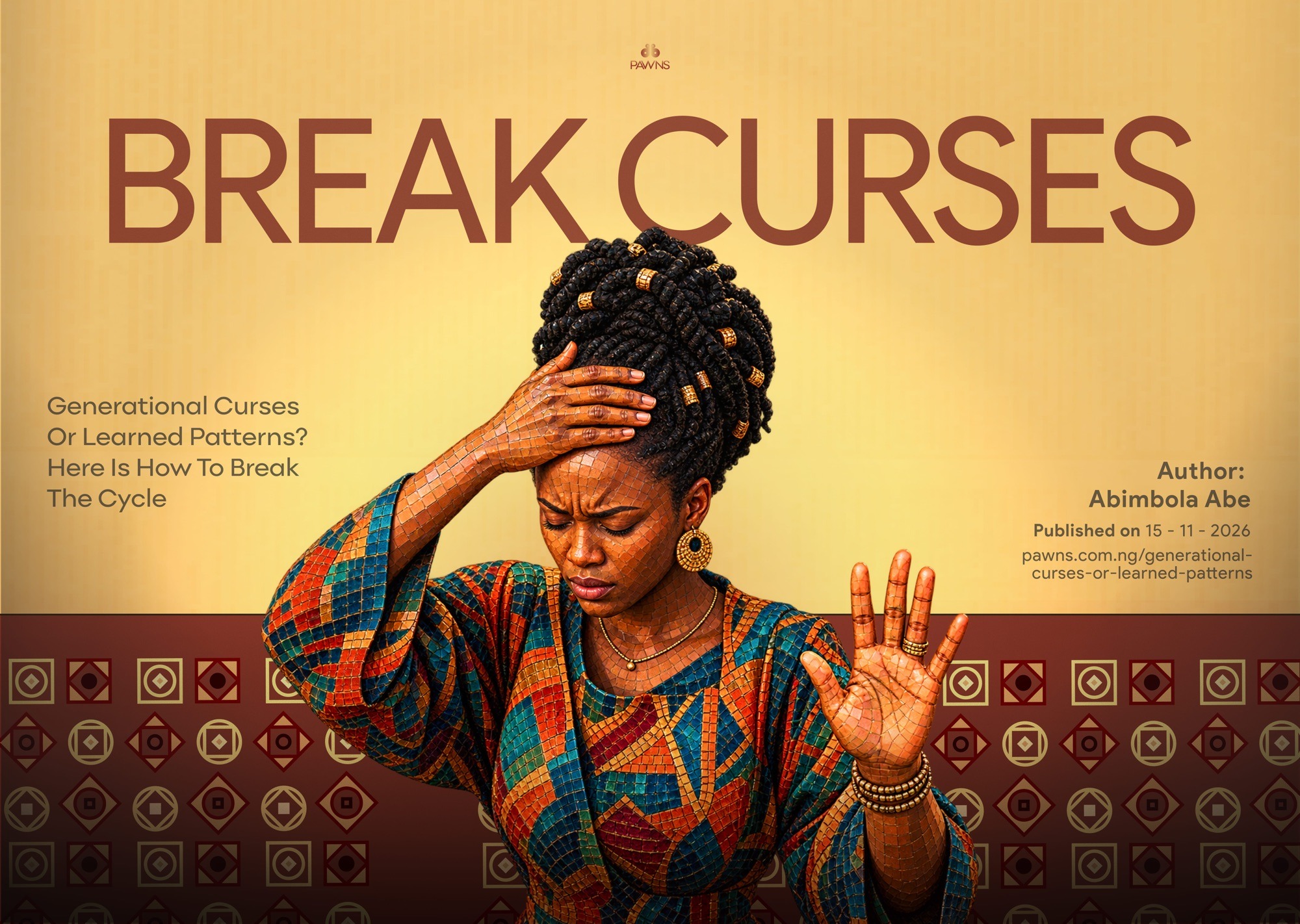


I was about eight the first time I heard a pastor talk about generational curses. He told the whole church to stand up, place our hands on our heads, and cancel every curse from our father’s house and our mother’s house. I shouted “Fire!” like everyone else, and as I grew older, I did it again and again.
Praying to break curses and escape the sins of past generations became a normal part of my childhood.
And as a child, I quickly learned that problems ran in families, and you had to pray them off.
But as an adult, I’ve started to wonder: what if what we call generational curses are really just patterns? Habits, wounds, and limiting beliefs that get passed down without anyone paying attention.
In this blog post, I’ll share why I’ve come to see it that way, and what I’m doing to break out of the cycle.
What Generational Patterns Look Like in Real Life
I recently read a Zikoko article about a young man who earns ₦3 million a month but gives away 80% of it and keeps no emergency savings. Before I’d finished reading, I suspected the belief behind it came from his childhood, and I was right.
He grew up believing money was evil and that rich people were destined for hell. I’m no prophet, but unless something changes, he’ll likely pass the same belief on. I wonder if, three or four generations down the line, his descendants will be in church trying to break the “generational curse” of poverty.
I see a similar pattern in myself. Growing up, investing was seen as a risky venture. Nobody around me really did it, and when it came up, it was usually a story about a cousin who invested wrongly and lost everything, or a project that crashed. The belief was that you should keep your money somewhere you can see it, not put it somewhere you can’t, where it could disappear. So that just felt like common sense. Even now, it takes extra effort for me to invest, even when I know it’s the smarter choice.
It’s the same with how I handle my feelings. At home, we didn’t really sit down and talk about how we felt. If something was wrong, you kept quiet and moved on, because keeping quiet was part of being a good child. So I learned that not causing trouble was safer than saying how I felt, and I still catch myself bottling things up until I can’t anymore.
It can run through a whole family too. Think about a family where marriages rarely last. A child grows up watching every disagreement end with someone slamming a door or not speaking for days. Nobody ever shows them what it looks like to talk a problem through, so silence and walking away start to feel normal. When they get married, they do the same thing, because it’s all they’ve ever seen. And if you ask them about it, they’ll simply say, “That’s just how we are in this family.”
And when the same thing happens over and over again, everyone calls it a generational curse.
But none of this makes our families the villains. Most parents were simply living the way they knew how, and the children were doing what children do best: copying what they see.
So is it really a curse, or something we learned without noticing?
Why Do We Blame Generational Curses For Our Suffering?
I’ve realised that blaming a curse for the patterns we find ourselves trapped in is easier than looking more closely at where and how it started. If the problem started with some great-grandfather nobody remembers, then nobody alive has to take responsibility for it, and nobody has to have that awkward conversation with their parents.
We may not have the guts to sit our family down and have that difficult talk about how money is handled, misunderstandings are approached, or partners are chosen. We don’t want to be seen as arrogant, imposing, or prying. But we can fast for three days, go for a deliverance service, or sow seeds with hopes that something magical happens overnight. And we keep at it even when nothing really seems to be changing, because when that’s what you hear from the pulpit every Sunday, it’s hard to think there is another way.
It took me years to finally take a hard look at my own family, notice that the same things kept repeating, and start looking for a practical solution.
Signs a “Generational Curse” Might Be a Pattern
So how do you know when a “curse” is really a pattern? These are a few things I’ve noticed:
- Other people in the house pick it up too. I have a friend who lived with her extended family for years. In that house, whenever something went wrong, it was put down to a spiritual attack. While we were talking recently, we realised she’d started doing the same thing, and it had made her outsource every responsibility to someone else. She didn’t choose it. She just lived in that environment long enough to pick it up.
- You can point to the exact lesson. In my family, it was “keep your money where you can see it.” Once I could name the belief, I didn’t need a supernatural explanation for why investing felt so hard.
- It changes when the environment changes. A distant relative of my mum’s comes from a family where marriages never seemed to work out. But when he travelled out, his life turned out differently. I don’t think he prayed the curse away. He just found himself in a different environment, around different examples.
- Nobody talks about it. In many Nigerian homes, there are things you just don’t ask about, like how much your parents earn or why your uncle’s marriage ended. So nobody questions it, and you grow up thinking that’s just how life is.
In each of these examples, nobody needed a deliverance service to explain what happened. The answer was right there in what they saw and heard growing up. And that’s good news, because unlike a curse, a pattern is something you can actually work on.
How to Break Generational Patterns or ”Curses”
Just because that’s how it has always been doesn’t mean that’s how it should be. Most people who grew up with harm don’t go on to repeat it. It takes conscious effort, but the cycle can be broken. Here is how to do it:
Notice the pattern.
For me, the first step is awareness: taking note of recurring patterns and asking where they might have come from. For instance, I used to struggle to make friends. When I tried to work out why, I remembered my parents always telling me not to make friends, because friends would end up distracting me from my path. So, deep down, I had this conviction that strangers were dangerous, or even foes that must not be brought close. And, the thing is, when you have such a mindset, people can sense the energy – that suspicion – and that repels them.
Make sense of your story.
Once I’ve spotted a pattern, I try to understand it. You don’t need to have had a traumatic childhood to start examining it. Even if your childhood felt normal or even perfect, you still need to make sense of it.
For me, that looks like journaling and going to therapy. Writing things down helps me spot what keeps repeating, and therapy helps me understand where it came from. The goal wasn’t so that I can go on blaming them, but that I could simply know what to work on in myself.
Writing essays helped too, because putting my story into words forces me to look at it honestly. The biggest thing I’ve realised is that a lot of what I thought was just my personality, like keeping quiet, finding it hard to make friends, or being scared of investing, was actually learned. It was not “How I am”.
And if I learned it, I can unlearn it. Understanding this has made me a bit less hard on myself, and on my parents, and shifted my attention to unlearning what I didn’t want anymore while learning what I needed.
Do one thing differently.
Understanding a pattern is one thing, but changing it is another, and it rarely happens in one big moment. For me, it’s as small as being the one to reach out first, saying yes to plans when my instinct is to stay home, and showing up for people I like in small, consistent ways, until making friends starts to feel normal instead of risky.
Don’t do it alone.
None of this is easy, and you don’t have to do it alone. Safe, supportive relationships are part of what helps people break it. You need people who can help you hold the change when old habits try to pull you back, and for me, that’s my friends and the people in my family who are also trying to do things differently.
Keep the blessings.
And while you’re working out what to let go of, remember that families pass down good things too. Not being allowed many friends meant I spent a lot of time alone, reading and using my imagination.
Now, as an adult, I’m not scared of boredom, and I can focus on a task for longer than most people I know. So breaking a cycle doesn’t mean rejecting everything. We just have to choose what to keep.
Conclusion: You Can’t Pray a Pattern Away
Looking back at all those Sundays, I understand why breaking curses meant so much to us. We’re always looking for a reason for what we can’t explain, and a curse was a readily available, yet inaccurate reason.
For many people, faith is one of the ways they heal, and I wouldn’t want to take that away. Perhaps they call it a curse while treating it as a pattern they slowly unlearn. I won’t judge them for the framing.
However, a pattern doesn’t leave just because you prayed against it. It leaves when you make the conscious effort to name it, and do the slow, difficult work of doing things differently.
As the saying goes, doing the same thing over and over and expecting a different result is the definition of insanity.
I don’t shout “Fire!” at curses anymore. These days, I journal, I go to therapy, I write essays like this one, and I try to catch the pattern before it repeats itself. Some days I catch it, some days I don’t.
But whatever I carry forward from here, I hope it’s the blessings, not the curses.
***
Found this insightful? Please leave a comment and share with friends and family who might need it.
Below are some other pieces you might find insightful:
- How to Change Your Life When You Feel You Can’t: An Interview With Chione Hardy on Why Change Is Only As Hard As You Let It Be
- Why I Don’t Believe In Prayer Anymore:
- How I Changed My Life and How You Can Too
- African Renaissance: Why the Battle for a Better Africa Starts With Your Thinking
- Identity Is Destiny: How To Shape Who You Become By Changing How You See Yourself


Abimbola Abe is the co-founder of Launchstack, a marketing and automation agency. She is a writer and thinker passionate about self-development, philosophy, and the way we experience life.
Beyond writing, she trains individuals and businesses on leveraging AI to improve productivity and streamline operations. Through her work, she helps people and brands work smarter, grow faster, and navigate the evolving digital landscape more effectively.