
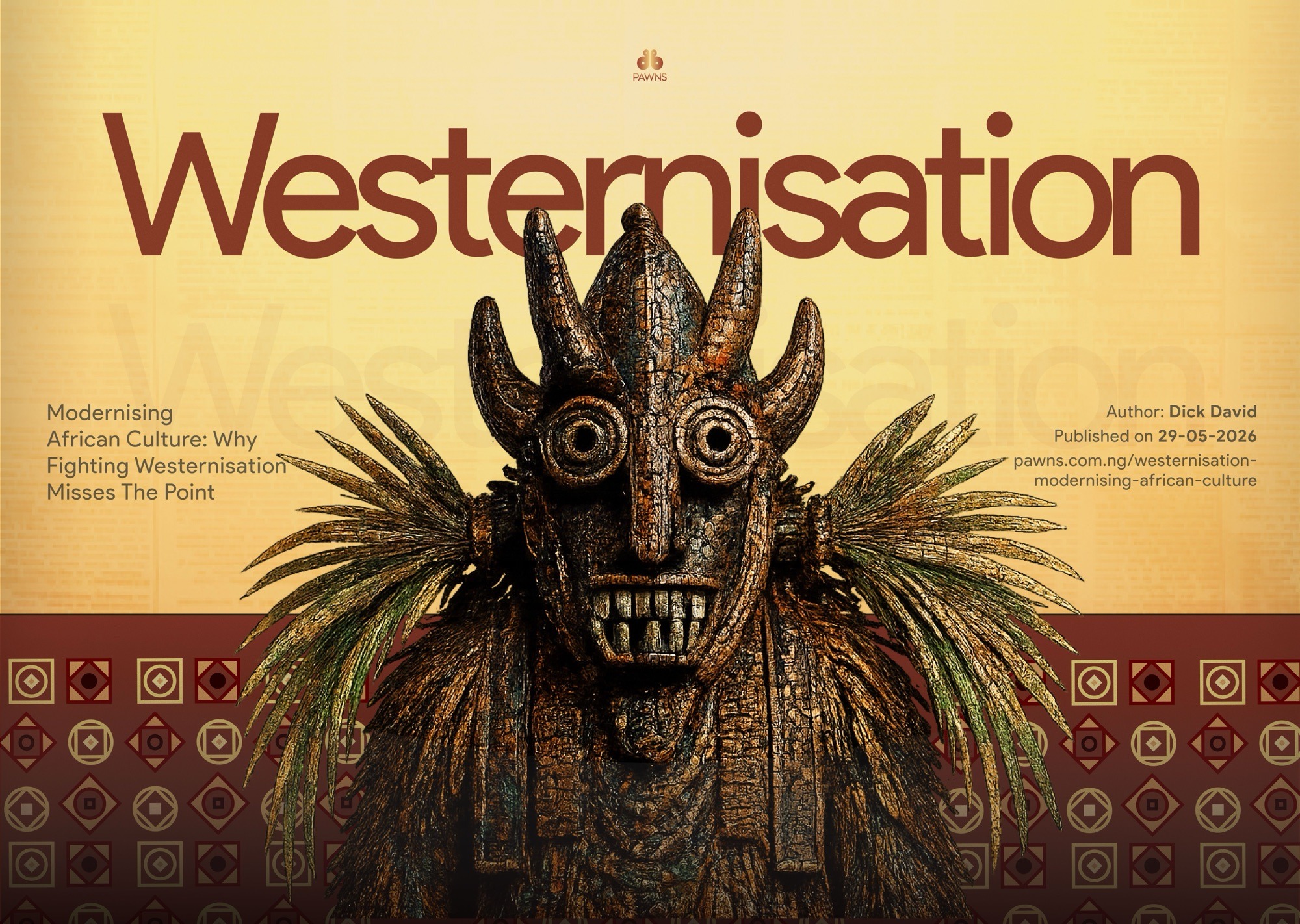


Have you ever been in a room where people sort of just romanticise their local culture, affirming things like masquerades and bride prices during marriages? How about where people attack what they perceive as Westernisation, frowning at things like LGBTQ+ rights, as well as birth through Caesarean section?
If you met me a few years ago, I would think for a moment and say, I am not one of those people, I prefer the Western culture over our local African culture.
But that would be inaccurate.
Why?
Because it is confusing modernisation with westernisation.
Sadly, unless you studied courses related to social sciences or have read up on these, chances are that you can’t tell the difference either. You might even be conflating colonisation, westernisation, and modernisation.
So before we proceed, let’s clarify.
Colonisation, Westernisation, And Modernisation: What’s The Difference?
Colonialism (along with the slave trade) wrought so many atrocities, some of which we are still recovering from. It imposed taxes, borders, and so many harmful things with the sole aim of controlling and extracting from Africa. Even the Western education and religion introduced were mostly to get people to fall in line — to act as the Westerners wanted, which, to a large degree, was an imposition of their Western way of life – which is their culture. And this westernisation, to a large extent, had its pros and cons, just like every other culture in the world.
However, such imposition of culture was not done only by Europeans. It was more or less the norm for much of the world for centuries. From the Hellenization of the Middle East under Alexander the Great to the Romanisation of Europe, conquerors have systematically forced their customs, laws, languages, and sometimes religion onto the subjugated. Africa, or more correctly, some parts of Africa, happened to be among the last in that long history of domination, transformation, and exploitation. Though some argue that it persists in other forms, what is now called neo-colonialism, but that is a topic for another day. The point is that colonialism was mostly exploitative of the land, destructive of local culture, and hence never something people chose voluntarily — not in Africa, and not in any part of the world at any point in history
However, most of the world moved on from this, taking elements of their conquerors to be even stronger, better people and societies. For instance, when the French invaded England in 1066 and banned the native tongue from schools and courts, the English responded by absorbing about ten thousand French words to create Middle English, documenting it into the language that evolved into the global English we speak today. Similarly, when Western warships cornered Japan in the 19th century, the Japanese realised they needed modern machines for defence, and so they quickly studied and adopted the technology. Furthermore, the Japanese also took that mechanical knowledge and applied it to their traditional crafts, using industrial tools to refine and mass-produce their textiles, metalwork, and pottery. They integrated all the good from their horrible past, and carry it with pride so that even today we admire them, rather than pity or shame them.
Every single developed country has modernised – they adopt better technology and social systems, even if it was from their sworn enemies.
However, perhaps, because the traumatic past is still relatively fresh in the minds of Africans, they generally feel suspicious and even some animosity towards whatever they sense to be the Western way of life. But what many Africans don’t realise is that even Western culture is still undergoing evolution. From dressing to family structure, how they lived has drastically changed. So the Western culture that was imposed during colonisation is not exactly the same as what is practised today. Something has been changing it. And that something is modernisation.
Modernisation Is Not Westernisation
Think of someone who grew up in a typical Nigerian village — with no network and no electricity — who moves to Abuja and, after a few months, starts ironing their clothes and going live on TikTok. They simply saw, liked, and embraced the culture in Abuja. So too people choose to start working remotely, eat more fast food, and go for medical diagnosis when they feel ill. They don’t do it because of shame or fear, but because it offers a functional advantage in an advanced world. They adopt it because it works.
The same applies to social shifts. Sociologist Everett Rogers argued in his work on the Diffusion of Innovations that ideas spread when they offer a genuine advantage. For instance, women in Africa didn’t start seeking equality because they were brainwashed by Westerners. Rather, they got fed up with the subjugation, limitations, and neglect of the existing African culture, which is patriarchal in nature.
Modernisation is simply people recognising a better way of living and reaching for it.
While there is genuine room for arguing and pushing for the protection of our cultural heritage, it is important to see where they fail, where they get it right, and where they can improve. Because human nature will always seek what empowers it — consciously or unconsciously — and any impediments to this will only give way or lead to great suffering.
My hope for writing this is that it helps more Africans better adopt modernisation, just like people in Europe and Japan have, without necessarily compromising their culture.
“I do not want my house to be walled in on all sides and my windows to be stuffed. I want the cultures of all lands to be blown about my house as freely as possible. But I refuse to be blown off my feet by any.”
– Mahatma Gandhi
Why We Must Embrace Modernisation, Despite Its Messiness
There is seldom anything that comes from humans that is purely good. Why would we expect such purity when each of us is impure in our own way? Many medical breakthroughs came from experimenting on people. Slaves built many civilisations and wonders of the world. And even capitalism, which has driven countless innovations today, has also mostly killed off the village and communal lifestyles.
Yet these things persist because they all have practical use, and it is only when better alternatives emerge and stand that we move on to them. Yet, it is seldom a dramatic shift. For instance, we don’t have slaves today, but we still have civil servants. We don’t use humans for experimentation, but we still have lab rats. We are not so proud of the past, but we are doing better, based on it.
In Africa, the English language came through colonisation, which was ugly. But it is a beautiful thing that we can read and write today in English, which was itself developed through non-glamorous means, as stated earlier. Anyway, reading opened us up to centuries’ worth of knowledge — from literature to science. Today, someone speaking sound Ogba language might be applauded in Omoku, but even people sharing the same broader Igbo dialect would struggle to understand them, let alone the rest of the world. And when last did you find a literature or scientific publication written in Igbo? As the world gets more interconnected, the need to speak a more common language only increases.
With English having one of the largest vocabularies of any language in existence — estimated at over a million words — absorbing so much from Germanic, French, Latin and other roots, it is particularly effective for precise expression and communication.
To reject the English language, or other modern inventions that came from the West (though didn’t necessarily originate there), is like deciding to level the Colosseum or tear down the U.S. Capitol because they were built by slaves, or refusing birth control pills because it was perfected by experimenting on women, hundreds of whom died.
Is It a Struggle Between Africa and the West, or Africa and Modernisation?
In conversations like this, people tend to sort of hypocritically ignore that planes, phones, the internet, and a lot of the amazing things they enjoy today didn’t originate from their tribe, culture, or country. However, I think they should admit this. And then go a step further to ask why that is the case.
If they do this, they would quickly find the secret is that Westerners embrace modernisation unabashedly. And it is exactly the reason other parts of the world, like Asia, which have done the same, have started contributing more to the world.
For instance, Africa has a lot of herbalists. These people know about the herbs and roots. But instead of modernising — using refined tools and documenting their process — they rather shroud it in “mysticism”. As a result, their solutions are unpredictable and ineffective, sometimes even harmful, hence unreliable. Whereas doctors, from China to France, simply study, brew, and test their medicines to get the right dosage, understand the effects, and package them in tablets and capsules for easy administration. The same with our architecture. We use mud and thatch. These aren’t necessarily primitive. In fact, they make sense for our climate and what is available to us. Even our arts and music face thesame issue. Look at Western classical music, and you will see that the extraordinarily sophisticated harmonic progressions are well documented in musical notes and taught in music schools. But traditional African music, which is far more sophisticated in rhythm, is not documented anywhere. And as a result, it is mostly fading out.
So it is not that one tradition is simply better. It is that some people have learned to modernise.
This is why I am very proud of
- Artists like Neco Novellas have taken up the challenge of modernising African music by translating our complex oral rhythms into written scores so that even European symphonic orchestras can play them, earning him centre stage on major projects like HAEVN’s Symphonic Tales.
- Architects like Olajumoke Adenowo do the same for our architecture and buildings by turning traditional, climate-smart layout logic into world-class blueprints—a feat that made the Royal Institute of British Architects name her a global inspiration and got her book published by Rizzoli. And,
- Scholars like Anselm Adodo have taken our herbalism out of the shrines and into labs, and stripped it of its mysticism by testing, standardising, and repackaging the remedies as liquid oral solutions, capsules, and ointments, many of which are officially registered with NAFDAC (National Agency for Food and Drug Administration and Control).
The world will always recognise real value — but it has to be modernised.
It is not a battle between Africa and the West, but Africa and modernisation.
But perhaps the main friction is from the fact that modernisation highlights the issues with our African culture.
African Cultures Have Serious Problems
Take polygamy. You say preserve our culture, but how come when Nollywood makes a movie or a Nigerian author writes a play, the stepmother is almost always wicked to the stepchildren? That is not coming from nowhere — it is the expected story.
The studies actually explain things. From the Cinderella effect — which highlights the statistically higher incidence of abuse, neglect, and infanticide committed by stepparents against stepchildren compared to biological parents — to the internal rivalry that ravages families, sometimes across generations, having more than one wife comes with issues. Even meta-analyses of studies across multiple countries show that women in polygamous marriages are significantly more likely to experience depression, anxiety, and low self-esteem, while children in polygamous households show higher rates of emotional and behavioural problems and lower academic achievement.
Anyone watching that movie or reading the play with some sense would think: maybe I really don’t want this in my life. And they are right to think that. That culture was toxic as hell, even though some of our ancestors managed to make it out in one piece — though bearing many traumas within. People are not just choosing monogamy because Westerners told them to, but because they are fed up with polygamy.
Nevertheless, when we get it right, even the West comes to copy. You see people on social media creating content around coming to Nigeria just to taste our egusi soup, suya, and roasted corn — and they love it so much they even start making the dishes back in their countries using modern equipment. For instance, I once saw a video of an Asian lady making pounded yams with an electric blender rather than using the manual, extremely stressful wooden mortar and pestle.
Aside from our prestige bias — that is, the human tendency to copy behaviours from groups they perceive as more powerful or successful — people tend to choose what works and what is better. If it is not really good, it fades quickly.
As Arjun Appadurai, an Indian-American anthropologist and expert on globalisation, argued, the spread of global culture doesn’t produce simple Western dominance; instead, it produces hybrids. Afrobeats is the perfect Nigerian example. Same with South Korea’s K-pop.
So if there is something genuinely good in African culture — and there is — the work is not to protect it from the world. The work is to modernise it and show the world what it is missing. Yes, we can make pounded yams with an electric blender rather than a mortar and pestle, and use 3D printers to create more intricate and beautiful fashion accessories like beads and footwear.
We can modernise Africa’s culture.
Western Religion Is Not Modernisation
Western religion is not modernisation.
Religions seldom arrive as one option among many or without coercion. Often, they show up as the only option, with grave consequences for rejecting it.
What choice do you really have when the alternative is eternal damnation or having your head chopped off?
Religion has often travelled the same way colonialism did — as part of a larger coercive project, dismantling existing systems of knowledge, governance, and identity to make room for itself. From colonial missionaries who beat slaves into accepting Jesus to modern-day jihadists who bomb Allah’s name into dominion, religion comes to impose, not to give you a choice. The soft evangelism often happens way after the religion has taken root.
Unlike technology or human rights, religion is rigid, hardly changing, and closed to feedback. It poses as the single answer to the multiplicities of questions, contradictions, and paradoxes that make life convoluted and jarring. Everything it touches conforms to it. No amount of data will shake a genuine religious conviction, because data was never the point.
This is why it cannot be modernised the same way our food, architecture, or music can. And this is why it is dangerous when it takes over.
Take Iran. Before 1979, women could wear what they wanted, work in most professions, and had significant personal freedoms. After the Islamic Revolution, mandatory hijab laws were introduced, the legal age of marriage for girls was dropped to as low as nine at one point, and a woman’s testimony in court was legally valued at half that of a man’s. If Islam takes over the United States today, that would be their fate. That is what happens when something that cannot be filtered takes over the filtering process itself.
Indeed, Westerners brought the Christian religion, which lead to the destruction of artifacts (like the Benin Bronzes and Igbo-Ukwu sculptures), the demonization of tattoos and markings (like Ichi facial scarification and Yoruba tribal marks), the stigmatization of afro-textured hairstyles (like Irun Kiko threading and shuku styles), financial extortion (like the high-pressure demand for compulsory tithes, “First Fruits,” and “Seed-Sowing”), the erasure of indigenous medicine (like the suppression of Dibia and Onishegun pharmacology), the repression of traditional names (like replacing “Sangoyomi” or “Agwuncha” with “David” and “Mary”), the loss of oral history (like the decline of Iwi Egungun chants and village moonlit storytelling), and even the criminalization of non-binary identities (like the Yan Daudu and female-husband traditions).
Nevertheless, it is mostly up to us to choose whether to free ourselves of it or not. Interestingly, most people choose to blend their traditional religion with the dominating religion, a mixture which many at both purist ends frown at.
In essence, Christianity, Islam, or whatever new religion dominates is not necessarily modernisation or even Westernisation, just as slavery or colonisation does not belong to anyone. I suggest we abandon religion, but that’s a topic for another day.
Conclusion: We Don’t Need Westernisation; We Simply Need To Modernise African Culture
I think modernisation is a good thing.
Modernisation led to the abolition of slavery in European countries before it cascaded down to Africa. It led to improvement in medicine, so that we now have caesarean sections performed safely all over the world. And Santa is just a modernised masquerade that brings joy to millions of people (rather than striking terror like ours does).
But the twist is that we never needed Western intervention or morals. Long before European arrivals, sovereign nations like the 14th-century Kingdom of Kongo enforced strict anti-slavery laws to protect their citizens. In East Africa, 19th-century medical practitioners in the Bunyoro-Kitara Kingdom successfully performed Caesarean sections using highly advanced indigenous methods, sterilising their tools and anaesthetising patients with banana wine. Culturally, had we institutionalised and elevated centuries-old traditional festival masquerades—such as the Yoruba Egungun or Igbo Mmanwu—they would easily be global attractions today, celebrated much like the Western Santa Claus. Even fluid frameworks of gender and identity, which were historically normal across pre-colonial African history, are now being packaged and exported back to Africa as LGBTQ+ rights. We did not need to be colonised to progress, nor did we need Western culture; we simply needed to modernise African culture.
Even where our historical practices failed us, modernization gives us the tools to fix them. For instance, India realized that their traditional dowry system was a financial burden that often resulted in domestic violence and extreme family bankruptcy, so they passed the Dowry Prohibition Act to criminalize the practice, shunning centuries-long cultures. The young grooms even stand up to parents who demand it, insisting they would not take a single rupee or material bribe for a wife. In like fashion, we can modernize our African culture by abandoning long exorbitant marriage lists and hefty bride prices that often leave young couples starting their lives in debt. And instead, we can focus on gifting long-term investments like stocks and shares to secure their financial freedom.
Modernizing the culture is not disrespect to it. There is no pride in sticking to ways that harm people, becoming more retrograde, or offering nothing to the world
We should be proud of African culture, I agree. But there is no pride in staying stagnant, regressing or offering nothing to the world. Think of the Himba people. Their culture is as pure as it gets. But what have they contributed beyond their own borders? What part of their culture does the world emulate? At worst, they are treated like relics from the past, at best like tourist attractions. Sure, their lives have value, and their existence is meaningful. Perhaps they are even happy. But their contribution to humanity is almost non-existent.
If your dream for African culture is for it to be pure, untouched, and irrelevant to the larger human story, then suit yourself. But don’t complain when younger generations who want to be more, contribute more, and experience more abandon that African way.
For me, I choose what has real utility and promotes human wellbeing.
I don’t care so much if it was my father’s or forefather’s practice.
I am not pro-West, or anti-Africa. I am pro-human.
How about you?
***
If you found this piece insightful, please commend and share it with friends and family.
Below are some other pieces you might like:
- Cultural Provocateurs: When Deference Becomes Dangerous (And How to Question Authority From Where We Stand)
- African Renaissance: Why the Battle for a Better Africa Starts With Your Thinking
- Crafting a Better Nigeria: Why Your Work Should Be More Than A Means To Money
- The Feminists Have A Point: “Patriarchy Is Problematic”
- Rising Above A Corrupt World (with emphasis on Nigeria)


Dick David is a freelance SEO content writer and editor with over 7 years of experience in content writing, digital marketing, and sales. He is the founder of Pawns Digital Agency. Throughout his career, he has authored over 4 books, published hundreds of SEO articles attracting thousands of monthly visitors, ghostwritten numerous works, and edited hundreds of content pieces across various industries. Currently, he works with Robert Taylor Media and has also worked with Tobi Digitals and Branditechture Design Agency, among others.