

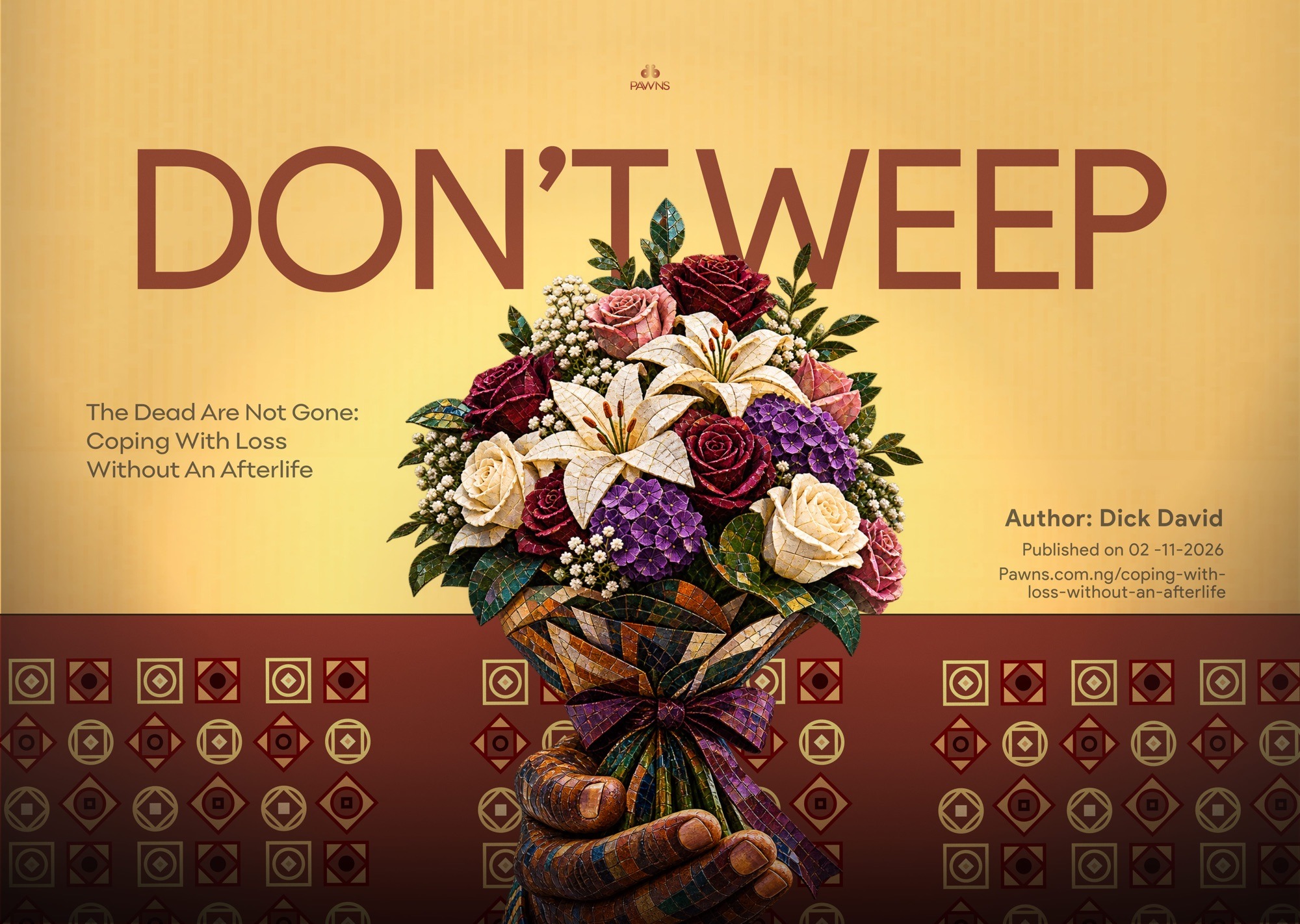


My dad died in 2021, and I haven’t had a moment of despair. I haven’t even been able to shed a tear, perhaps because I don’t think he is fully gone.
When I was much younger, we watched a lot of Christian cartoons, many of which were about Jesus’s crucifixion.
I was often intrigued by Jesus’s attitude in those final moments. I would watch him walk the street with a heavy cross on his shoulders. And when the women who loved him started crying as they trailed behind, he would look at them and say, “Do not weep for me…”
Why would he say that?
And when Mary Magdalene found his tomb empty and started crying afresh, he appeared to her and asked, “Woman, why are you weeping?”
It seems as though he never really registered the idea of being gone. He didn’t treat death as final. Even when his friend Lazarus died, he wept, though it seems it was over the way the people around him perceived death.
I don’t believe in a literal resurrection, or in any afterlife, but I hold the same conviction that death is not the end of a person, and despair is not the best way to meet it.
Because, when you think of it, it’s over 2,000 years since the story took place, yet the name of Jesus has never been spoken, published and printed as much as it is today. Everywhere you turn, a Christian is trying to be like Jesus, embodying his character and teaching you his values.
In that sense, isn’t he more present than he was 2,000 years ago?
That is my point.
My dad may have died a few years ago, but I see parts of him all around me, in myself and my siblings. And the character he instilled in us, we are instilling in our children.
Think of an orange tree. It bears fruit, and when the seeds are planted, they grow into trees that bear even more fruit. Soon you have a whole plantation of oranges.
But we struggle to see it that way. We want our loved ones with us as they were, like a child holding on to an orange, unable to see that when it is buried and decays, its seeds will grow into a new tree.
We change all through our lives. From unconscious zygotes to mature adults, we transform. Death is only a continuation of it, the final transition into a new form.
The New Form: Death Is Not Really the End of a Person
We don’t cry when people sleep. We don’t say they are not there because they are unconscious.
None of us was conscious before we were conceived. Consciousness only emerged as our brains developed. But it is not always there. When we sleep, faint or go under anaesthesia, we are not conscious. Yet we are there.
Our consciousness is only a part of us.
We are also our thoughts and character.
Thoughts and character that another person can inherit and preserve.
And the more people hold on to it, the more present we are, like Jesus in the hearts of billions of believers today.
Don’t Weep: How the Dead Live On Through the Living
See, we don’t demand that babies do things around the house. We don’t expect kids to work. Yet we value them all the same.
So why expect the dead to be around, enduring the drudgery of life?
If they lived well, they’ve done their part. They’ve left this “world” of pain and suffering. They are now in a form unaware of the mundane existence we endure, like someone in deep sleep, only without a working body.
But this does not mean they have nothing to offer us anymore.
For the couple of years Jesus spent with his disciples, they mostly watched him work. But when he was gone, his teaching and character motivated them to do more than they would have done alone.
Sometimes, absence increases influence.
Sigmund Freud, the renowned psychoanalyst, once said, “No one could be a man unless his father has died.”
It sounds bleak, and maybe, to some degree, it is. But this death doesn’t always have to be literal. Sometimes it happens when the child realises their father cannot always be there to protect, provide or answer all their questions. And so they become a father to themselves, gaining independence and authority over their own life, just like their father.
Haven’t you seen children striving to live up to their parents’ reputation, uphold their legacy and fulfil their parents’ dreams just after their parents’ passing?
It is almost as if the parents live in their hearts, living indirectly through them.
Indeed, we don’t need an afterlife to cope with the death of a loved one. We embody them in our thoughts and actions.
Conclusion: The Dead Are Not Just in the Grave, They Are in Our Hearts and Minds
It is okay to miss and even mourn the older form.
Parents miss the feel of carrying babies and playing with the kids. But they don’t wish for children to remain children forever. They accept the growth, and find meaning and enjoyment in their new age and form. So also we can accept, and find meaning in, the new form of our loved ones when they pass.
Because in truth, they are still with us. Every atom that composed their physical form still circulates the planet: in the rain that drums on our roofs, in the dust of the harmattan, even in the air we breathe.
Their bodies dissolve into nature and become part of it, just as their ideas and character dissolve into us and become part of us.
It is a beautiful transformation, and a powerful realisation: that we keep living in the form of memories and ideas after death, affecting the lives of people we love and shaping reality long after our bones decay.
It may not be an afterlife, but it is a real way to exist after death.
And perhaps that is reason enough to put effort into distilling our thoughts and refining our character: to be so present in our absence that when our physical forms disintegrate, there may be no reason for despair.
Because we are not just in the grave, but in their hearts and minds.
So when you catch yourself cooking the way they cooked, gesturing the way they gestured, or acting the way they would have acted, pause. Remind yourself that that is them in you.
***
Did you enjoy reading this piece? Please leave a comment and share with friends and family.
Here are some other pieces you might like:
- Death Makes Everything Meaningful [Here’s Why]
- 3 Liberating Lessons From Overcoming Death Anxiety: How to Live Despite Fear And Uncertainty
- Death Anxiety In 20s: Why You Shouldn’t Fear Death, And How To Cure Thanatophobia.
- You Are More Than A Body; [How To Never Die In Real Life]


Dick David is a freelance SEO content writer and editor with over 7 years of experience in content writing, digital marketing, and sales. He is the founder of Pawns Digital Agency. Throughout his career, he has authored over 4 books, published hundreds of SEO articles attracting thousands of monthly visitors, ghostwritten numerous works, and edited hundreds of content pieces across various industries. Currently, he works with Robert Taylor Media and has also worked with Tobi Digitals and Branditechture Design Agency, among others.



This is a beautiful read
Glad you like it
Please don’t forget to share