


WhatsApp Status has an option called Hide. It makes sure new status updates from specific people on your contact list stop showing up on your status feed. I use it often, as I don’t necessarily want to block or cut contact with these people. It is just that a lot of what I see on their status is Pseudo-intellectual, and it gets under my skin.
The Meaning of Pseudo-Intelligence
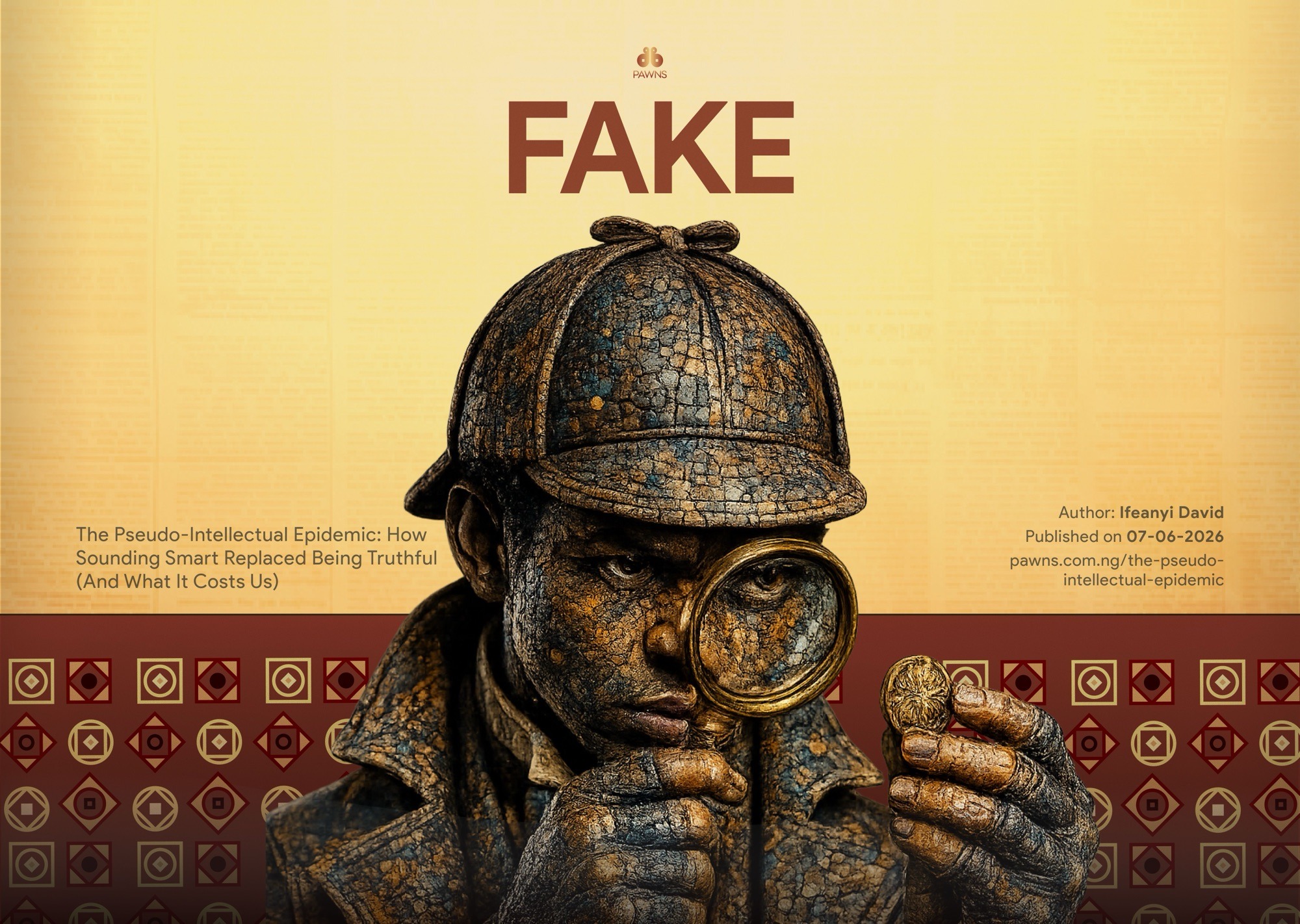
Pseudo-intelligence (or pseudo-intellectual) is not a common word you hear in everyday conversation. But it describes many of our everyday conversations, especially online.
Anyone who pretends to have, or exaggerates their knowledge and intelligence without having a deep understanding of the matter, is a pseudo-intellectual, and that half-baked knowledge they purport is pseudo-intelligence.
Their opinions are diluted takes – especially on complex topics like religion, business, politics, health or relationships – delivered with confidence, often with little or no care; no regard for whether it is true, reliable or within the context of the audience.
What matters to the pseudo-intellectuals is the looks – the idea of appearing intelligent and sophisticated. Hence, when pressed with a counter-argument, their shallowness surfaces: what sounded like insight turns out to be nonsense, or residuals from past pain. And since they care little about the ideas and more about appearance (of being right, smart, or sophisticated), they don’t accept correction, they defend, deflect, or attack.
I know the temptation to sound smart, to impress people or to stroke the ego. I succumbed to it in my early stages as a writer. It is something I now stay conscious of.
The rest of this piece will explore why pseudo-intellectualism is becoming worse by the day, the dangers it poses and how we might counter the wave.
Where the Problem (of Pseudo-intellectualism) Started
Perhaps it started as early as our first day in school, within an educational system that rarely cared whether we actually understood anything, or whether the method of teaching matched the way a particular child’s mind worked.
In school, memorising letters and numbers, then spitting them back out, is treated as the ultimate proof of intelligence. I could never do that. I think slowly. I have to wade through a messy phase of uncertainty before I finally see things clearly. And even when I get there, finding the exact words or symbols to explain my understanding is a struggle. Because all of this takes time, the school system wrote me off as dumb.
But thinking slowly is not a sign of being dumb.
This isn’t entirely the teachers’ fault. They too are trapped in a system built on volume; too many students and too much content, with too little time to teach it properly. Naturally, immediacy and performance become the only metrics that matter. Which makes you wonder: how many students actually internalise the lessons, versus simply learning how to game the system and fake their way through?
Safe to say, the problem is in part a colonial inheritance. The education system the British left behind was built with limited aims: to produce people who could follow instructions, fill the lower rungs of a civil service, and replicate what they were told. It was never designed to encourage independent thinkers. And even where it produced sharp minds, the system around them never changed — a system designed just to obey orders seldom works for a country trying to build and develop.
To this day, most systems across many African countries still advocate the exact same things: immediacy over accuracy, and performance over nuance. Put simply, we were raised in classrooms where appearing right mattered more than being right.
…and then we got smartphones.
How Smartphones and the Internet Gave Everyone a Voice and Removed the Bars
Once upon a time, due to the cost of writing and publishing essays, journals, or books, ideas were hard to spread, and even when they did, they travelled slowly. Markets, churches, town squares, and letters were the easier and faster ways to voice thoughts. But those conversations never compounded or reached millions. They remained localised, unsearchable, and vanished the moment the conversation ended.
Entering the published discourse meant piercing through a gauntlet of gatekeepers – publishers, editors, and reviewers – who filtered what made it into the permanent record. Mostly refined ideas survived this process.
For instance, Chinua Achebe spent years as a broadcaster, novelist, and witness to the Biafran War before making political commentary, through his book The Trouble with Nigeria in 1983, at 52 years of age.
Then, there is Dele Farotimi, who practised law for nearly two decades after being called to the Bar in 1999. He founded his own firm in 2002, built a reputation handling high-profile litigation, retired from active practice in 2018 at 50, before he published Nigeria and Its Criminal Justice System in 2024, at 56.
Achebe and Farotimi, however, weren’t just institutional graduates. Years of honest engagement with the very thing they were speaking about earned them authority.
But the advent of smartphones and the internet has given everyone a chance to voice their opinions.
On one hand, it opened the door for real thinkers with no patience or resources to share ideas without institutional bias blocking them. On the other hand, it flooded the space with pseudo-intellectuals who polluted the knowledge pool with noise.
This is worse on social media platforms, where the algorithms do not care if something is true. Rather, they care if it holds people’s attention.
- A post that confirms biases gets commented on.
- A post that makes people happy gets liked and saved.
- While posts that demand the people to slow down and think gets swiped away.
These platforms simplify and sensationalise almost everything to kill the zest to think. And since they can’t monetise thinking, they monetise the scroll, the reaction, the outrage, and the share. Pseudo-intellectuals know this. That’s why they trade in emotion. They build on the outrage and ride the toxicity into fame and wealth.
And when pseudo-intellectuals consistently show up as the top content creators, influencers, or coaches with sharp-sounding takes, they don’t just get noticed; they become the standard.
What Happens When Pseudo-intelligence Becomes the Standard
In December 2024, a BBC World Service investigation exposed how Steven Bartlett’s wildly popular podcast, The Diary of a CEO, amplifies dangerous health misinformation. Researchers analysed 15 health-focused episodes and found scientifically unfounded claims recurring across nearly every one.
Guests were allowed to make sweeping, unchallenged assertions, like treating cancer with a keto diet, branding COVID-19 as an engineered weapon, and “curing” autism or PCOS through diet alone. While these guests were introduced as leading experts, Bartlett offered little to no pushback. Whether he simply didn’t know better or chose not to challenge them out of respect, the result was the same: his massive platform legitimised and spread these fringe ideas.
Dr. Heidi Larson, an expert in public trust in healthcare, warned the BBC that these guests were “way overstretching”. She highlighted how this vastly accessible, unscientific content ultimately pushes people away from evidence-based medicine.
Bartlett’s platform is only one among thousands.
In Nigeria, a herbal medicine vendor known as Baba Aisha, who calls himself Dr Salisu Sani Na Wagini, sells a product called Sacra Herbs for ₦100. In a nine-minute advertisement that opens with a prayer, he urges parents not to take sick children to the hospital.
“Even if you have the intention to go to hospital, don’t go,” he said. “Even if you go, they’ll only say your children need drip or add them blood.”
Despite presenting himself as a professional with years of claimed results, a five-month investigation by Dubawa, a West African fact-checking organisation, found no evidence that the concoction cured illness. Yet hundreds of thousands of bottles were reportedly sold every month.
After analysing the product, Professor Olaposi Omotuyi, a Professor of Computational Biology, said: “It makes kidney and liver function almost impossible. That means anyone who takes this is at a high risk of acute kidney injury, if not chronic.”
Pseudo-intellectualism appears in different costumes, not just in health. And where it takes root, it creates the conditions for something worse: outright fraud, manipulation, and insidious agendas.
For example:
- In finance, during the 2017 Bitcoin bubble, John McAfee publicly fanatically claimed Bitcoin would hit one million dollars before the end of 2020. It never happened. When it failed, he dismissed the prediction as “a ruse.”
- In nutrition, Teami LLC paid celebrities, including Cardi B and Jordin Sparks, to promote detox teas that claimed to fight cancer, unclog arteries, and cause weight loss. The Federal Trade Commission later found no reliable scientific evidence behind these claims.
- In relationships, Andrew Tate ran an online course called Pimping Hoes Degree (PhD), with over 140,000 members, teaching men about wealth and relationships. He has been quoted as saying women “belong to the man,” framing relationships through rigid hierarchies that reduce human connection into transactional scorecards.
- In education, students routinely use SparkNotes and CliffsNotes summaries instead of reading assigned books. A summary of a four-hundred-page book is now often treated as understanding, creating the illusion of knowing something that isn’t really known.
- And in religion, clergy men, David Ibiyeomie of Salvation Ministries, Port Harcourt, Nigeria, have told his congregation that failing to pay tithes makes you a “criminal”, and perpetuates near–success syndromes.
And because we feel we “know” these public figures, we trust them, even when their claims are untrue, baseless, and manufactured. And that misplaced trust costs time, money, and sometimes lives.
Thinking Clearly in a World That Rewards Noise
Someone reading this might argue that this itself is pseudo-intellectual writing. Writing about media, power, and public performance without a PhD or twenty years in the field.
Fair point.
But there is a difference between thinking through an idea in public and pretending to have solved it. I am not writing this because I have solved everything. I am writing because I keep encountering the problem, and I want to think through it honestly. The research I have pointed to is real. The examples are verified. And if something here is wrong, I am humble enough to accept corrections and improve my thoughts.
That’s kind of the point.
There is a widely cited psychological finding called the Dunning-Kruger effect, documented by David Dunning and Justin Kruger in 1999, which observed that people with limited knowledge in a subject often overestimate their competence. They concluded that the less people knew, the more certain they tended to sound.
That explains a great deal about what we see online every morning. From the finance expert on X with only three months of trading experience to the relationship coach on TikTok who has never sustained a healthy, long-term relationship.
The antidote to our current dilemma is not simply acquiring more information. It begins by thinking slowly. By pausing to say, “I don’t yet understand this”. It is learning to say “I don’t know” without cringing. And doing this can be tough in a culture where the appearance of flawlessness and infallibility are celebrated. Yet, you must understand that humility and admission of ignorance are prerequisites for meaningful inquiry.
Philip Tetlock studied what separates good thinkers from poor ones. He found that the best forecasters, those most consistently accurate about complex questions, shared one habit above all others: they updated their beliefs when new evidence arrived. They did not treat changing their minds as embarrassment, but as progress.
Abraham Lincoln, one of America’s greatest presidents, became one of history’s clearest thinkers because he tested ideas against reality and changed his positions when facts demanded it – notably his profound evolution in both his approach to slavery and his management of military leadership.
The difference between expertise and pseudo-intellectualism is not whether we know everything. It is whether we keep learning. And pseudo-intellectuals do the opposite.
So how do we curb their effect on us?
How To Mute the Noise (And Check Ourselves)
We filter.
If we understand how little we know, and how easily the wrong ideas can lodge in the brain, we become more careful about who shapes our thinking. When I encounter a new claim, I try to read beyond the headline. I sit with the idea long enough to find its edges. I ask whether it can be falsified. I check whether the person making it has ever changed their mind before.
The moment I feel certain about something I learned last week, I pause. The moment I want to share a hot take before verifying it, I slow down. The moment I feel defensive about being corrected, I pay attention.
Pseudo-intellectualism is not just something other people do. It is a reflex many of us fall into when emotions feel more expedient than the truth. Still, personal discipline alone cannot solve this completely. As audiences, we also need to stop rewarding people who never admit they were wrong. I hide certain accounts. I curate who I follow. I pay attention to people who show intellectual honesty, humility, and the ability to admit when they are wrong.
The forces driving pseudo-intellectualism are deeply embedded, and it may be difficult to build systems that reliably distinguish intellectual rigour from what merely sounds convincing. Yet some attempts are worth noting.
In 2021, X introduced Community Notes, a crowdsourced fact-checking system where users add context to misleading posts. TikTok and Meta later announced similar misinformation-management approaches.
The system might not be perfect or foolproof. But they seem to be improving. And the best we can do is be a part of that — to keep thinking and verifying, before believing and acting.
Conclusion: Sustain The Light With Intellectual Humility
Why am I talking about pseudo-intellectualism? Nigeria’s problem is deeper than that. Sure, it is. But the proliferation of bad ideas makes every other problem harder to solve.
In Nexus, Yuval Noah Harari argues that information is not the same as truth. Human societies have always been held together not only by facts, but also by stories, myths, emotions, and shared illusions. More information does not automatically make people wiser. Sometimes, it only makes confusion spread faster.
If we cannot tell the difference between truth and something that merely sounds convincing, we remain stuck. If we reward immediacy more than accuracy, performance more than nuance, and charisma more than honesty, we build a culture and society stuck in the dark.
Perhaps, that’s why the intellectuals are called the enlightened – they bear the light.
***
If you found this helpful and true, then someone else might need to read it today. Share with them.
Below are some content you might like too:
- Thinkers Vs Think-Nots: Why Taking Responsibility For Your Life Starts With Taking Responsibility for Your Thoughts
- Framing, Context, and Content: How Thoughts and Thinking (Re)shape Your Reality
- The Courage to Be Wrong: Why Authentic Self-Expression Is Your Path to Freedom and Growth
- Reframing Your Flaws: How Embracing Your Difference Can Make You Extraordinary
- The Door of Your Mind: Why Critical Thinking Trumps Closed-, Narrow-, and Even Open-Mindedness.


David Ifeanyi is a mindful SEO content writer, photographer, and photo retoucher with over 3 years of experience.
His works help people value themselves and their experiences more. Over the years he has inspired countless people to embrace their uniqueness and become better versions of themselves.
David has worked with several brands, including Tobi Digitals, ReelCliq, and Black Aperture. And has been a huge player in the growth of Pawns Digital Agency.