



Our thoughts don’t originate from us. Like water in the water cycle, thoughts flow into us, marinate, and flow back out in a circle of ideas. And like water, thoughts give life to our being.
Our thoughts make us who we are — successful or unsuccessful, happy or unhappy, good or bad. So it matters — deeply — what you let in.
I have been born-again, vegan, vegetarian, and so much more. All of it came from thoughts that flooded my mind at the time — from home, television, and books. And today, I am none of those things, because I changed those thoughts.
I chose veganism to save the planet. When I realised it wasn’t the solution, I adjusted to a vegetarian diet, then dropped dietary restrictions entirely. I chose Christianity to be close to God. When it left me feeling conflicted, I moved to Omnism, then left religion altogether.
In those in-between phases, I felt torn. Sometimes afraid.
But when you practice — with courage — examining and letting go of deeply held beliefs, you eventually learn to trust yourself as you shape yourself.
This piece is not just a guide for questioning and abandoning ideas. It is about reclaiming agency over who you are.
But first, let’s explore some key ideas.
Thinkers
“The threads of society intertwine us, yet we are the ones who do the weaving.”
Every single morning, my dad read the Bible to us during morning devotion. As a preacher, he didn’t just recite — he explained the scripture in detail, drawing parallels to things that had recently happened at home. Those teachings were sandwiched with songs and prayers. God was not some ethereal being we visited once a week at church. He was someone we first acknowledged every single morning — an integral part of our lives.
I inherited those religious beliefs without questioning. But the interesting thing was, my dad never shunned questioning. So when my questions started coming, they were not squashed — which was a good thing.
Although my dad also inherited his beliefs from his father, his personal beliefs were layered, anchored in philosophical questions he had gone great lengths to understand — studying and wrestling with them. Perhaps that is why he became a preacher in the first place. His inquiries into the big questions of life drove him to know far more than the average person handed weak answers by an unscrupulous preacher.
While my dad wasn’t thrilled about my gradual disengagement from religion, I think he would be interested in the depth of thought that led to it. Just as I suspect he would be proud of the depth of thought that led my brother to become a preacher.
People see my brother and me and wonder how we relate — I act allergic to religious ideas while he actively promotes them. The secret is that we are both thinkers, even if our frameworks often conflict.
It is at conflicting intersection that you find Christian-leaning thinkers like Jordan Peterson in conversation with atheism-leaning thinkers like Alex O’Connor. Or AI accelerators like Sam Altman engaging seriously with the ideas of AI safety proponents like Eliezer Yudkowsky.
That is how ideas improve — when they battle each other, give and receive blows, and come out better and stronger on the other side.
Sadly, not everyone who holds an opinion has actually thought about it, even if they think they have. And because they never really thought about the opinion, an attack on it feels like a personal attack.
And it gets worse.
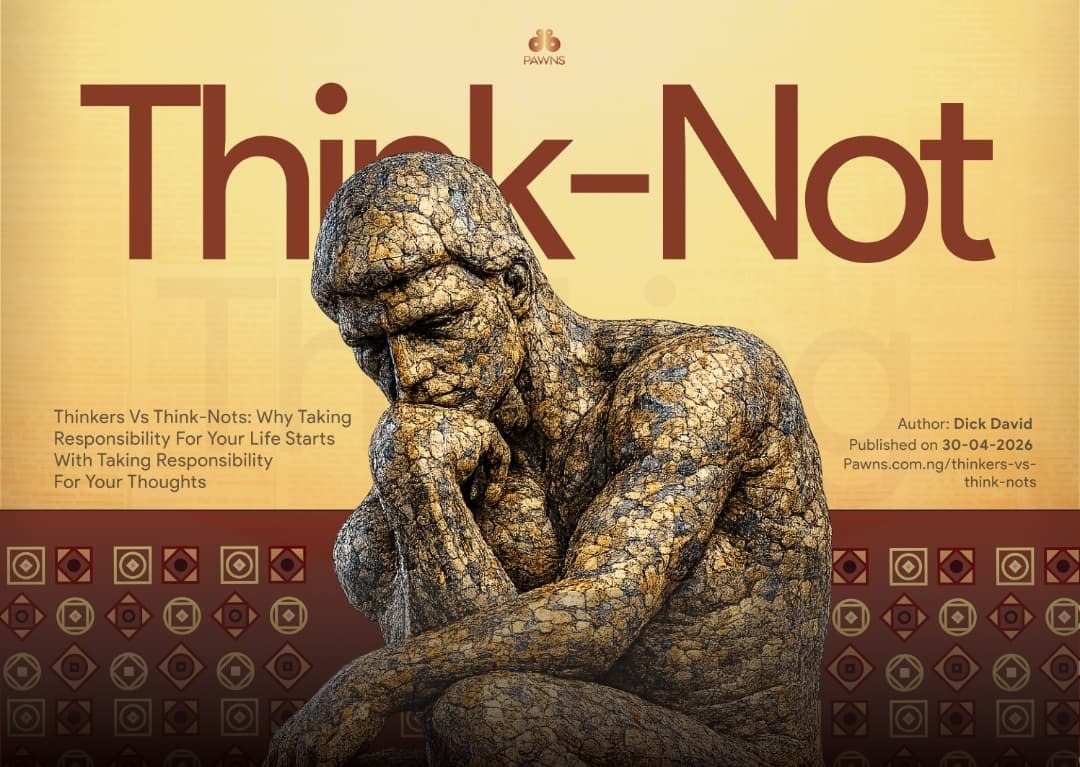
Think-Nots
“I don’t think, therefore I don’t exist.”
I either have deep, delightful conversations with people, or we disagree so sharply it is hard to respect them.
At first, I externalised the blame — calling them dumb or stupid. Later, I internalised it — calling myself insufferable or impatient. I concluded I either had to make peace with their thinking or filter out those who didn’t think like me.
But what I eventually found is that the issue isn’t that they don’t think like me. It’s that they are not thinking at all. They are what I refer to as “Think-nots”
Think-nots absorb, work with, and spew ideas they have never actually contemplated. They support opinions simply because of where those opinions came from — defending till death the views of their pastor, favourite musician, or parent, even when those views are riddled with holes, opposed to reality, or plain harmful.
Think-nots are the ones who gather the wood and light the fire when the priest declares some poor widow a witch. They are the ones who dress a certain way because “everyone” said it was dope.
You can tell they never thought about it because their justifications give themselves away. “Why are you burning her?” Because the priest said she’s a witch. “But why did the priest say she’s a witch?” — and that’s when they get angry. Not confused. Angry. Because your question isn’t just challenging a claim. It’s threatening the structure underneath it.
“Why are you dressed that way?” Because everyone thinks it’s cool. “But why does everyone think it’s cool?” — and now they’re looking at you like you’re the problem.
…
Because thinking is hard and places responsibility squarely in your hands, Think-nots far outnumber Thinkers.
So it is no surprise you see people acting like a herd — saying the same things, chasing the same things, with no personal direction. Their mistakes are not their own, but the person they follow. Their minds are photocopies of someone else’s thoughts.
To distinguish yourself from them, you have to think. Actually think.
How To Actually Think: Characteristics of Thinkers
Maths is usually considered the hardest subject, even though it requires the least memorisation.
There are hardly any definitions. And if there are, the best teachers seldom obsess over you restating them accurately.
They are obsessed with the steps. They care about the method.
In a 10-point question, the final answer might only be worth 2 marks. The other 8 are earned in the rigour of your work. You could get the right answer by a lucky guess and still fail. But if your method is sound and you make a tiny slip at the end, you still walk away with an A.
This transcends the classroom.
In the ethical and moral domain, you often find people doing the right things for the wrong reasons. A religious person might not lie or kill because they fear disobeying a commandment. On the surface, that sounds fine. But it also means they could deceive or kill the moment they believe that same authority instructed it. History is littered with atrocities committed in the name of obedience.
If the only answer is “Because God said so”, “It is written”, or “The Prophet commanded it” then anything becomes permissible if you can be convinced it was said by God, the text, or the Prophet.
But the person who doesn’t rely on ready-made answers has to work it out, step by step. They don’t need to cram commandments. They arm themselves with tools and methods to derive a befitting answer for themselves.
This is why the need for Thinkers is growing.
Our old scripts have no chapters on the ethics of AI, the personhood of a clone, or the digital ghosts of our loved ones. The world is evolving too fast for the past to hand us easy answers.
When the map is blank, you have to become a cartographer. When there are no easy answers, you have to become a thinker.
So what are the specific qualities that define a Thinker? Below are a few.
Thinkers Separate Their Identity From Their Ideas
Think-nots treat an idea like a limb — cut it off and they feel pain. A thinker treats an idea like a coat. If it no longer fits, or the weather changes, they take it off.
In psychology, this is called Identity Decoupling.
It is why thinkers can be brutally honest with themselves — watching something they have believed for decades get torn to shreds without flinching. But a think-not will lash out the moment you challenge their views, no matter how careful or respectful you try to be.
A thinker who originally believed eating strictly vegetables was good for the planet would not hesitate to change their stance when evidence shows it is not sustainable at scale — though still a valid personal choice for some.
Pick any strong opinion you hold and argue the opposite side — not to change your mind, but to see if you can. If you can’t construct a decent case against your own position, you haven’t really thought about it. A thinker can steelman the opposition. That’s how you know a belief is actually yours.
Thinkers Focus on the Basic Facts
Thinkers are not attached to consensus or conventional wisdom. They have a healthy disrespect for authority and the crowd. They don’t care who said it or how many people agree — they care whether it is true, and they try to thoroughly understand the basis before accepting any conclusion.
This is known as First Principles Thinking.
A thinker breaks every claim down to its most basic, atomic truths. Like Newton observing the apple fall and deducing the Laws of Motion, thinking from first principles means stripping away assumptions and focusing on the facts.
A thinker who originally believed the presence of a hymen was what made a woman suitable for marriage would not hesitate to change their stance once they understand that the hymen is not a reliable proxy for character — and that character, not anatomy, is what produces healthy, happy marriages. The hymen is one of many body parts that can undergo irreversible change, but it is sensationalised because penile penetration is one of the more commonly known causes of that change — not the only one.
Thinkers don’t believe or do things simply because “that’s how it’s done.” They seek proof and act on evidence and reason.
Take one thing you “know” to be true and ask why — then keep asking until you hit a solid, verifiable fact or you hit nothing. Bedrock is good. Air means there’s work to do.
Thinkers Treat Ideas as Works in Progress
Even with solid conclusions, a thinker knows they can always be improved. Their confidence lies not in their stance but in their process — like a bird that places its confidence in its wings, not the branch it perches on.
This is known as Algorithmic Thinking.
Thinkers have a method of filtering and processing data that checks for bias, inconsistencies, and error. If a belief breaks under the weight of new evidence, they don’t fall. They fly to a better one.
It is essentially the Bayesian approach — treating ideas as works in progress rather than endpoints.
A thinker who originally believed democracy was a fair and perfect system would not hesitate to revise that view upon realising that not all democracies are equally evolved, most are gamed by politicians, the masses are not always well-informed or capable of sound judgment, and the whole thing is extraordinarily expensive to run.
If something is “infallible,” it signals the end of thinking. No thinker holds an infallible idea — not even that the sun will rise tomorrow, however improbable it would be if it didn’t.
After any significant conclusion, ask yourself: how did I get here? If you can’t trace the steps, you didn’t really decide. Something else decided for you.
Thinkers Have a High Tolerance for Ambiguity
When there is no clear answer, a think-not grabs the first explanation that feels good, just to stop the vertigo. A thinker admits the ignorance and patiently applies the necessary methods to unearth the truth.
This is known as Tolerance for Ambiguity.
Thinkers are perfectly fine floating in the void of the unknown. They can sit in the confusion, the gap, the silence — until the truth reveals itself, rather than forcing a fake one.
A thinker who originally believed strict hygiene and avoiding germs was straightforwardly good would not mind sitting in the murky middle upon learning that lack of exposure to germs can trigger autoimmune issues, among other complications.
A thinker can explain to the extent of what they know without yielding to the compulsion to give a comfortable answer. They can imagine without holding imagination as fact.
Next time you feel the urge to land on an answer quickly, pause. Notice the discomfort. Sit in it longer than feels natural. The reflex to resolve uncertainty fast is how you end up with confident wrong answers.
Thinkers Relentlessly Think About Their Thoughts
If you ask a thinker how they reached a conclusion, they can walk you through it — the sequential, detailed steps of their logic — because they are aware of the thought process that led them there, whether or not the conclusion is correct.
This is called Metacognition.
The thinker’s ability to map their thoughts is also why they can edit and improve them. And that is why writing is one of the best tools of the thinker — it enables them to pull out, put down, and plough through their thoughts, over and over, until they catch their own logical fallacies before a claim leaves their mouth or a belief runs their life.
A thinker who grew up hearing “money is the root of all evil” doesn’t just accept or reject that claim. They trace it — where did I hear this? Who benefited from me believing it? What has this belief quietly cost me? By mapping the thought, they can dismantle it surgically rather than just suppressing it or blindly acting on it.
To the thinker, thoughts are not identity. They are transient indicators of what is going on inside. And sometimes, when they raise false alarms, they need to be reset.
Write it down. Whatever you believe, whatever has been quietly running your life — write it down. Not to perform it. To see it. Thoughts you haven’t written are thoughts you haven’t fully examined.
Thinkers Are Aware of, and Consider, the Frame
Think-nots make sweeping, generalised conclusions. Thinkers are careful not to carry the right conclusion into the wrong context. They know no answer is universal. They know context is everything.
This is known as Contextual Intelligence.
Thinkers always look at the frame around a question or problem. They know that if you change the level, boundaries, or environment, the truth might change too. They are also aware of contexts where objective truth doesn’t even exist — where it is a matter of individual feeling — and they can tell the difference.
A thinker who knows Picasso was a visionary artist doesn’t conclude he was therefore a good man, a good father, or someone worth emulating in life. Greatness in one domain is data about that domain — nothing more. The think-not who idolises a pastor, musician, or politician wholesale has made the same error: they’ve taken competence in one frame and projected it across all frames. That’s how you end up defending someone’s abuse because of their anointing.
When you catch yourself assuming a brilliant musician must have solid relationship advice, or that a successful entrepreneur must understand politics — pause.
Conclusion: The Quality of Your Life Is Tethered to the Quality of Your Thinking
In the past, if you were a slave, it was because you were born one. That was the case with many things. But times have changed. Today, you have agency — your fate is mostly in your hands.
But the hands only respond to the mind.
And a mind running on unexamined, inherited thoughts is not really yours. It belongs to whoever put those thoughts there first.
This is why we seek out coaches, therapy, and books — we are trying to break through the invisible ceilings of our own mental models.
It is not easy. But it is not impossible.
The quality of your life is tethered to the quality of your thinking. And thinking — real thinking — starts with actually examining what you think.
***
Did you enjoy reading this piece? Let us know your thoughts in the comments section below.
Here are some other pieces you might like:
- The Role Of Critical Thinking In Seeking The Truth. [+11 Critical Thinking Tools]
- The Door of Your Mind: Why Critical Thinking Trumps Closed-, Narrow-, and Even Open-Mindedness.
- African Renaissance: Why the Battle for a Better Africa Starts With Your Thinking
- Framing, Context, and Content: How Thoughts and Thinking (Re)shape Your Reality
- Arguments Can Make You Smarter: 5 Ingredients for Productive Debate


Dick David is a freelance SEO content writer and editor with over 7 years of experience in content writing, digital marketing, and sales. He is the founder of Pawns Digital Agency. Throughout his career, he has authored over 4 books, published hundreds of SEO articles attracting thousands of monthly visitors, ghostwritten numerous works, and edited hundreds of content pieces across various industries. Currently, he works with Robert Taylor Media and has also worked with Tobi Digitals and Branditechture Design Agency, among others.






Outstanding!
I enjoyed it from start to finish
Awesome ✨
I am glad you enjoyed it.
Don’t forget to share with friends.
This was such a great read. Calling people who don’t own original thoughts “think-nots” is both hilarious and oddly respectful.
I’ve seen firsthand how easy it is to become defensive about opinions you haven’t fully thought through. If I’m being honest, I used to be that person.
Lol
I think aside from critical thinking, we need to develop the skill of figuring out if someone is a “Thinker” or “Think-nots” before engaging with them. Because, time and energy are often limited — and the stress from arguing with the Think-nots is rarely worth it.
Thank you for reading Precious 🤗
Lol
Yeah.
I think on top of critical thinking, we need the skill to filter out the “Think-nots” because it is often futile engaging with them.
Thank you for reading.
Don’t forget to share with friends.
This touched me, and made me concede that perhaps, I haven’t been thinking sufficiently.
Most times, I fret about what people might think because like you said, we have a lot of “Think Nots” on the loose.
I’m sharing this with a couple of my friends, it was an extraordinary read.
Awesome
I am glad it made you pause to think
I think that’s the point. We can always strive to be better thinkers.
And, thank you so much for the share. We appreciate.
This is a great read. Thank you
I think one of the major reasons people are afraid of thinking is actually evolutionary.
Early man lived in groups, in caves. Their primary motivation was simple — SURVIVE. They observed the same things and arrived at the same conclusions.
Challenging existing beliefs or exploring uncharted territory often meant getting eaten by a wild animal or dying in the cold. They learned the hard way that to survive, one must conform. And that reality has been hardwired into us ever since.
I think it still plays a major role in how we think today. If thinking will lead me into uncharted areas, or toward something considered a taboo, I’d rather steer clear — survival instincts kicks in.
One place we see this most vividly is in the Eden story. The first time man thought for himself, he ate the forbidden fruit and was driven out of the garden.
With stories like that baked into our consciousness, it’s almost as though independent thinking is outlawed, and challenging pre-existing rules is taboo — probably for good reasons. 😁
Great piece, I must say. Today, even though the fear of being ostracized still lurks behind the curtains — and some radical, independent thoughts still attract severe pushback and punishment/consequences — we do have more agency than our ancestors ever did. Our fate is mostly in our own hands.
But the hands only respond to the mind.
And a mind running on unexamined, inherited thoughts is not really yours. It belongs to whoever put those thoughts there first.
Thanks, Dave.