


A friend forwarded me three troubling videos. In the videos, a woman was filming herself having sex with children. The children were said to be hers — making it both paedophilia and incest.
She kept looking at the camera, soliciting reactions, which suggested she was getting rewarded by the viewers.
My friend called her possessed (ascribing her despicable act to a supernatural cause). I called her sick (pointing out the psychology).
Then I told my friend that such things happen every day, even as we speak. And that’s part of the reason I abandoned the prevalent idea of a good God.
Indifferent or Evil: Why Won’t God Step In?
People believe God is omnipotent, omnipresent, omniscient, and omnibenevolent. Which is to say, they believe God is all-powerful, all-present, all-knowing, and all-good. They believe not only that God is capable, present, and aware, but that God is also inclined to act in their best interest.
So they pray, sow seeds, and even act right, hoping that God will come to their rescue. And when things turn out well, many do believe God did it.
However, I think that’s all really conceited, solipsistic, and insulting.
How so?
Well, when you consider that there are children being molested, how do you explain the silence and lack of intervention from that God? How is it that God would be moved to bless people’s businesses and grant their wishes to get admission into some university, while somewhere there are kids crying as a dildo is forced into their rectum for the viewing pleasure of paedophiles?
Is God really capable and aware but unwilling to help? Or is God willing but incapable?
This is the “problem of evil” — how it is that a good God permits so much pointless suffering — suffering that in no way adds good to the world; suffering that is simply destructive, in the present and in the future.
The logical conclusion is that God is either non-existent, powerless, or indifferent. And indifference is perhaps even worse than evil — because even many hardened criminals would intervene in such a situation, even if it meant endangering their own lives.
Many religious people often say God gave us free will, so it’s not his fault evil persists. They even argue that we, humans, are the ones being silent and indifferent in the face of evil — that we do the evil, and then accuse God of not intervening. But for crying out loud, isn’t it also their claim that God made the world and put everything in it? If that’s the case, then that makes God responsible for everything in the world. Several religious texts appeal to believers by reminding them how God cares, even for the birds and flowers. It sounds reassuring. But when you look at the world, it doesn’t seem like God really cares much about those who aren’t in privileged environments or societies.
If there’s war in your country, or a natural disaster, or you grew up in a dirt-poor family, or your mother happens to be a paedophile who also enjoys incest, then that caring God goes silent.
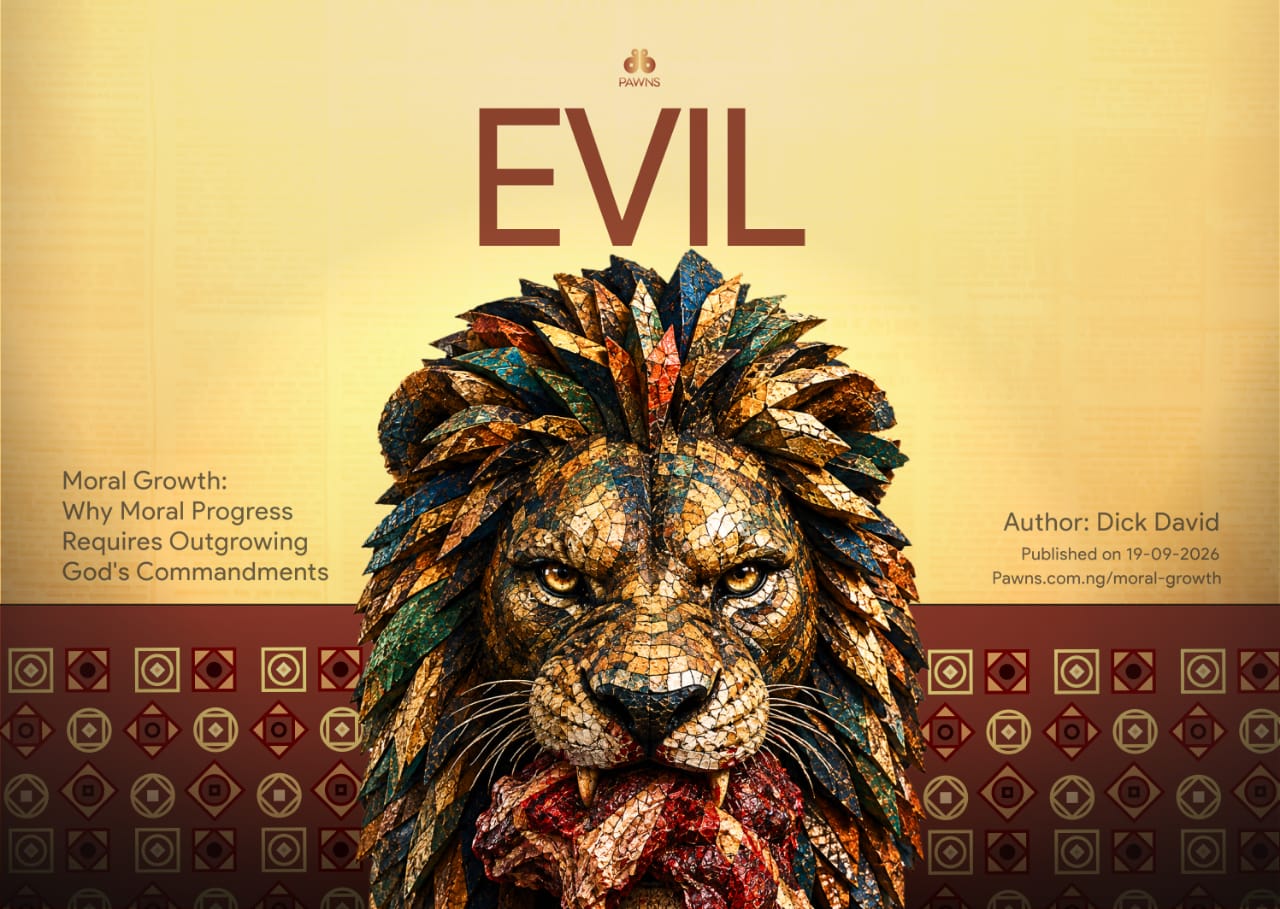
Heck, we feed prisoners and keep them from killing each other because we put them there. We never let known sex offenders near children, and we closely monitor and intervene when they do. It takes a very sick person to put a kid and a lion in the same room and then say they can’t intervene afterwards, for whatever reason they come up with. But that is exactly what the free-will argument suggests. Such an argument doesn’t just fashion God as indifferent, but evil — evil based on the moral standards we hold today as a species (more on this in the coming section).
Free will may explain the choice to abuse. It doesn’t explain how a good God can watch it happen, over and over and over again.
Some would say we’re too small, too limited to judge God’s reasons — that from way up there, the suffering might make sense in ways we simply can’t grasp down here. Fine. But that also means we can’t judge anything — we can’t say anything is good if we can’t call anything bad. In other words, we can’t think, but simply follow instructions because God knows best.
Reminds me of the story of Saul in the Bible, who refused to kill women and children, as well as that of Uzzah, who reached out his hand to steady the Ark so it wouldn’t fall. Both were punished for not obeying the instruction and instead trying to do what they thought was good. The point is, to truly follow the moral code of God is to stop trusting in one’s judgment entirely and simply obey, “for to obey is better than sacrifice”.
And Then They Killed God: How We Lost All Divine Moral Bearings
The famous German philosopher, Friedrich Nietzsche, wrote a striking parable. In the parable, a madman lit his lantern in the morning and frantically went about searching for God in the marketplace. He incessantly kept yelling, “I seek God! I seek God!” But since most of the people there didn’t believe in God, they laughed at him. So the madman jumped into their midst and, looking them in the eyes, accused them of killing God. It’s from this parable that the famous line “God is dead” originates. But I think what struck me most was when he lamented, “What were we doing when we unchained this earth from its sun? Whither is it moving now? Whither are we moving? Away from all suns? Are we not plunging continually? Backward, sideward, forward, in all directions? Is there still any up or down? Are we not straying, as through an infinite nothing?…”
His terror was that since we, humanity, have killed God (by no longer believing in him), we’ve unchained the earth, lost our bearings, and don’t know left from right any more — which is really the question the rest of this piece is trying to answer: if God’s dead, what fills the gap?
Indeed, today we have a world experiencing some vertigo from the mere fact that there’s no single authority left to instruct. These days, all we have is debates, amendments, riots, and more debates — both online and offline. Countries abide by constitutions, and the only place the commandments of God still seem to matter is within the four walls of a church or a mosque, as the case may be.
This doesn’t mean the world is atheistic. It just means humanity as a species has grown increasingly apatheistic — they don’t really care whether God exists or not, nor what he instructs them to obey. They simply act on their own.
There’s a quote often (mis)attributed to Marcus Aurelius which says, “Live a good life. If there are gods and they are just, then they will not care how devout you have been, but will welcome you based on the virtues you have lived by. If there are gods, but unjust, then you should not want to worship them. If there are no gods, then you will be gone, but will have lived a noble life…”
I really do love that quote.
But, of course, you know that to live this way requires overcoming the fear of damnation for not believing. It requires metaphorically killing God. Which, by extension, means taking full responsibility for defining what is good and bad, as well as the good and bad that happens around you. It means no longer waiting for some divine instruction to be good, or some divine intervention to stop evil.
Like the madman, many religious folks believe that without God there can’t possibly be a reliable moral compass. They believe good and bad are defined by God, and that those who ignore God are reckless and are bound to find themselves doing evil deeds.
However, if you look at the study, plenty of non-religious people have been observed to behave just as morally as religious people, and in some areas, they even score higher on specific moral traits, with better motivations behind their actions (rather than the sense of duty many religious people often have).
Moral Signposts: Who Decides What’s Right?
Right and wrong, good and bad, moral or immoral — these are not metaphysical facts. They are all human inventions. Just like we say green means good, or go, and red means danger, or stop. We use these to navigate a world that otherwise has no signposts.
Similarly, life really has no inherent moral code. You’d notice this if you look at the wild (even if that just means switching the TV to NatGeo Wild). In the wild, animals eat other animals — even their own children (filial cannibalism), mothers (matriphagy), or siblings (adelphophagy). They also mate with their children, parents, and siblings. We could go on and on — from killing off competing species (intraguild predation) to stealing other animals’ meals — these are simply things animals do to survive. And only a few of us get outraged by any of it, because that would be almost as absurd as getting outraged at the rain for beating a little bird chick to death, or a forest fire for killing off an entire family of squirrels.
We don’t place moral weight on animals or forces of nature. We just accept them for what they are.
But amongst ourselves, we’ve invented, institutionalised, and normalised moral codes — some written, most of it unwritten.
It’s at this point that religious folks tend to make the claim that God, or their religious text, is the objective standard. Or, even more conveniently, that it’s their God specifically who wired us to know good from bad.
But if you ask them how they know that their religious standard is the objective one, they’ll simply tell you it’s because it’s the word of God, or some other version of the same claim. That’s a circular argument trying to validate itself by itself (circular reasoning) — it’s like saying you’re the prettiest person in the world because your mum said so, and then telling us to believe you because she’s your mum. See how silly and frustrating that sounds?
But that’s not all. It turns out different “mums” exist — because different gods and religious texts have different moral codes, which different people who adhere to them believe to be the objective standard of good and bad.
All this to say, while religion and its texts have done a commendable job of upholding moral codes that have guided much of society, that’s not the same as being an objective moral code.
And the claim that God wired us to know what’s good or bad is an unfalsifiable claim, just as one could say God wired some people to be paedophiles. You’re free to believe it, but the key word is believe.
So how do we navigate the world if our moral codes are invented?
Well, we evolve — as always.
Evolution of Morals: How We Built Right and Wrong Without a Blueprint
Just like the evolution of species — where random genetic mutations happen, but only those that give an organism an edge in an indifferent environment get passed down — human behaviours evolve in a similar way. Random acts occur constantly, but it’s only the behaviours that give us an edge in living better that get transferred from generation to generation. Interestingly, those traits happen to be things like kindness, cooperation, and altruism. Stefan Klein called this “survival of the nicest” in his work, in which he explained how those traits ultimately increased our chances of success as a species.
Think about it — a few thousand years ago, it was more or less okay to own slaves. Even religious texts like the Bible detail how to go about it. It was also normal, even a divine charge, to harm and kill one’s enemies, equally endorsed by the gods. But today, almost no Christian would think it right to kill, and a good number of Muslims still feel uneasy about jihad.
Times have changed, and with that, our behaviours have mutated. Over time, we’ve distilled the best of them — the ones that gave us an edge — into moral codes.
And just like the evolution of physical traits didn’t need a God to engineer them to perfection, these moral codes have been engineered by the forces of cultural evolution too. Heck, even on the genetic level — since those who were good at being “kind” survived more, their genes got passed down more often — which over time changed our DNA, as well as the wiring of our brains, with empathy and trust hormones now in far greater abundance (essentially “domesticating” us). We didn’t need a God to embed or write moral codes into our minds. And if you’re thinking that just makes our morals evolutionary accidents with no real claim to being “right” — maybe. But that’s not a hole in the argument; it is the argument: there was never a cosmic or divine principle to begin with, just useful patterns that stuck because they worked.
This gene-culture coevolution isn’t unique to humans. When you look at other animals, you see they all sit at different levels of cognition. A single-celled organism simply responds to impulses. But as you go up the tree, you begin to see animals that are aware not just of themselves, but of others — animals with more evolved concepts of self, animals that can essentially empathise with another when one of them dies, animals with a sense of logic sharp enough to judge what’s fair. You see this in dogs, dolphins, and chimps. These animals never had a religious leader or read a religious text, yet they still know how to defend the vulnerable and risk their lives for their children — in some cases, for animals that aren’t even members of their own species. There are countless records of chimps protecting the weakest in their clan even when it’s not their child, dogs rescuing human babies, and dolphins saving people from drowning, shark attacks, or simply getting lost.
So how much more we, Homo sapiens, with minds so advanced they’ve literally built rockets that go to space and devices that can communicate from anywhere in the world.
While there may not be an objective moral code, we, by ourselves, have created something functional. Rather than screaming and beating our chests like a cheated gorilla, we have dialogues and courts.
Over centuries, we’ve kept constructing and reconstructing these codes, refining and sharpening them, generation after generation. This is how we’ve been able to reject slavery, misogyny, or homophobia even when religious texts technically permit or command them.
Today, even children who’ve never read the Bible or the Quran can act far more “righteous” than many saints and prophets in those religious texts.
Propaganda and Extremists: How We Talk Ourselves Into Cruelty
Yes, good and bad are not metaphysical facts. We constructed them.
But that’s not the same as saying they’re arbitrary, or a matter of majority rule. If that were the case, the trend in what’s permitted and what’s shunned wouldn’t be as consistent as it is. Like an expanding circle, our reasoning simply keeps extending that basic refusal to suffer to others — the same thing we don’t want happening to us, we don’t wish to happen to others. We extend it to people who are like us, then people who aren’t like us, and eventually to anyone capable of feeling pain like us.
When you look at the data, you find slavery is now illegal in every country on Earth. Child marriage rates have fallen globally. The killing of twins has been eradicated where it was once practised. And paedophilia and incest have become criminalised in almost every part of the world.
The fact is, every living thing wants to avoid unnecessary pain. And even those who wish to inflict pain on others often don’t want it falling on them or their loved ones. For instance, even if people enjoyed watching someone stoned to death, deep down they themselves wouldn’t want a stone landing on their own skull. So, generally, we gravitate away from such practices.
It takes a lot of work to get people to pursue unkind acts collectively against fellow humans. Take American lynchings for example — these were people who seemed to prefer a world where others suffered. Crowds gathered in the thousands, and postcards of the hanging bodies sold as souvenirs. But look closely, and you’ll find it took decades of dehumanisation and propaganda to strip the victims of their personhood first. The victims had to be characterised as non-human to the point that the killers’ Medial Prefrontal Cortex — the brain region responsible for recognising someone as a fellow human, not an object — was literally taken offline. This is why, when wars start brewing, rival leaders intentionally call the other group names like “swine,” “vermin,” “cockroaches,” and worse. They may even put out propaganda and narratives — like claiming the other group eats humans, or some other hideous thing — just to make their people feel nothing towards a fellow human.
Nobody celebrates torturing someone they still see as fully human, unless something’s malfunctioning in their brain.
Today, in most of the world, death sentences, even for serious offenders, are increasingly frowned upon.
While the examples given so far feel extreme, it’s the same simple mechanism driving more and more people to advocate against the marrying off of underage girls, the stigmatisation of gay people, and the subjugation of women. We’re almost instinctively driven to be fair and to protect vulnerable people.
In fact, at this point in human history, a lot of the suffering that persists is because people ignore their natural inclinations in adherence to an inflexible moral code they believe was handed down from above. Think about jihadists and Muslim extremists who strip women of their rights, ban them from schools, whip them in public, and worse — simply because that’s what the moral code dictated over 2,000 years ago, and it’s unchanging.
Conclusion: It Is Our Responsibility To Build a Morally Better World
My brother once shared a story with me. In it, he talked about a certain religious lady he was dating. According to her beliefs, it was wrong to eat “unclean” animals like snails and crayfish. My brother went to great lengths to explain to her that it was not wrong, even quoting the Bible for her. But she would not listen. It was not a big deal, so he let her be. After a while, he noticed her eating the “unclean” animals. Delightfully surprised, my brother asked her how come she ate these animals now. She told him that her pastor had informed them that it was no longer wrong to eat those animals. And immediately, my brother broke up with her.
I don’t know about you, but I wouldn’t want to date someone who simply obeys instructions rather than reason. And it is this same issue that troubles me when people say they rely on God (or more accurately, their religious texts and leaders) to tell them what is good or bad. They are halting their own evolution.
The reason someone like me often talks about God is not that I am angry with God. I don’t even care about that. Rather, I bring it up because I wish for more people to awaken to the monumental responsibility in front of us — the responsibility of thinking, debating, and deciding what is best for us all, rather than quoting some scripture and calling it a day. I don’t want to live in a society where we are punished for not obeying rules that are outdated and causing real suffering. I want to be with people who are working hard to get it a little less wrong than the generation before.
I don’t want to live with people who look at a God who watched little children being molested — and still call him good.
***
If you found this insightful or have questions, please let us know in the comments.
Below are some other pieces you might like to read:
- Should We Abandon Religion? Growing Beyond Blind Faith
- Religious Trauma: A Dark Side Of Religion [10 Steps To Overcome It]
- Why I Don’t Believe In Prayer Anymore:
- Being Better: Religion, Atheism, and Why Both Sides Fall Into the Same Trap
- Spirituality: A Path To Becoming Your Best Self [And The Role of Religion]


Dick David is a freelance SEO content writer and editor with over 7 years of experience in content writing, digital marketing, and sales. He is the founder of Pawns Digital Agency. Throughout his career, he has authored over 4 books, published hundreds of SEO articles attracting thousands of monthly visitors, ghostwritten numerous works, and edited hundreds of content pieces across various industries. Currently, he works with Robert Taylor Media and has also worked with Tobi Digitals and Branditechture Design Agency, among others.