
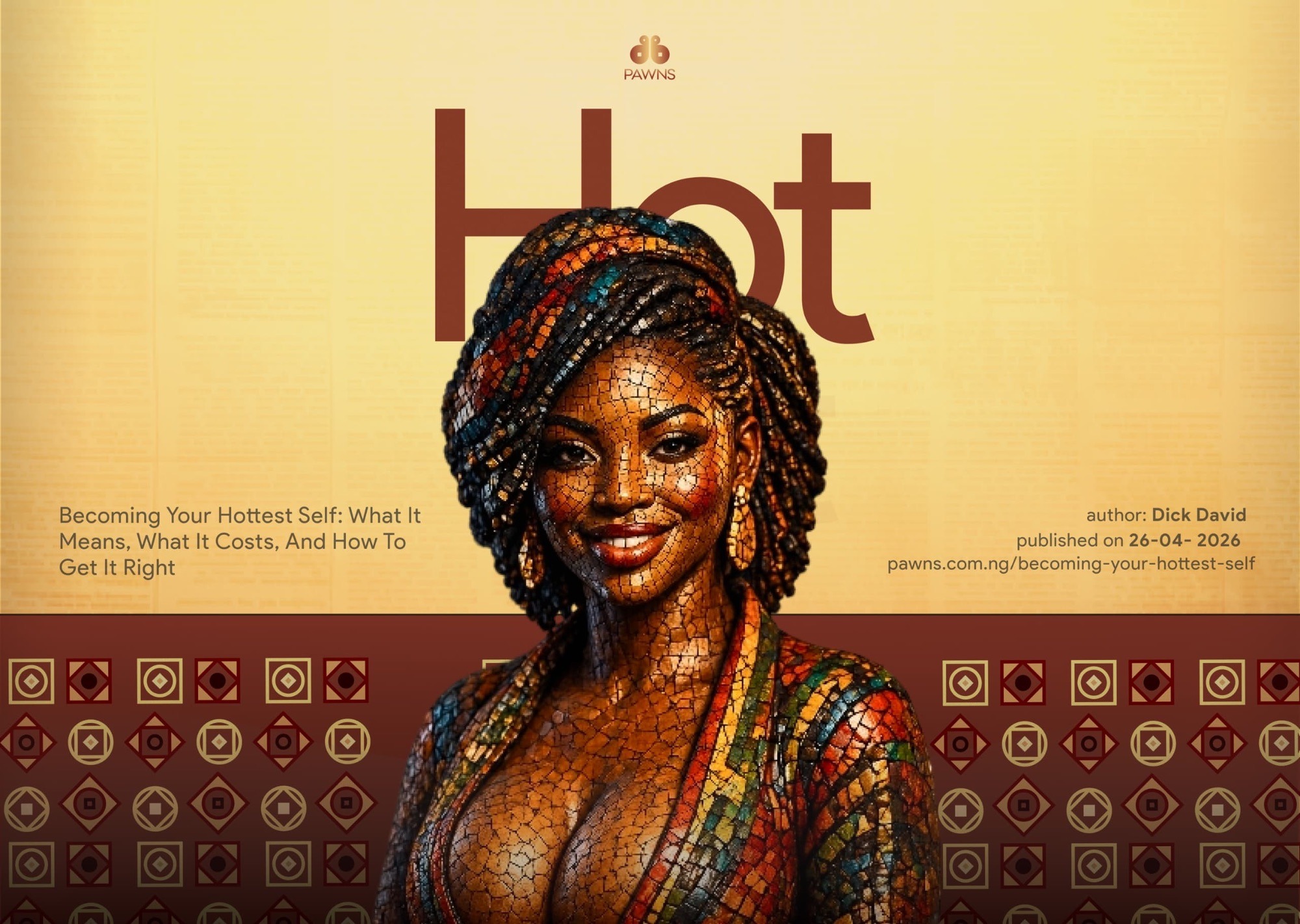


You want to glow up—to become 10X more attractive, sexier, and more admirable. You want to be “hot.” But what does it even mean to be hot?
Think about it, who is the hottest person you know, and why do you think they are hot?
When the topic of being hot is brought up, it is either brushed off as vain or collapsed into a list of hot celebrities. I bet you even thought of a celebrity when I posed the question earlier, and perhaps, some famous or popular person inspired you to want to be hot.
But the whole celebrity thing is like asking for the world’s healthiest meals and being given a list of popular fruits. Fruits are fine and healthy, but they lack the depth, complexity, and substance of an actual balanced meal.
The hotness of celebrities is usually based on the surface-level – the physical look, voice, or a curated demeanour from a movie or show. But real hotness is much more complex and nuanced; it is like Edikang Ikong—a delicious mixture and thoughtful cooking of many different healthy ingredients into one highly nutritious dish.
That is why, to me, one of the hottest people alive is Bozoma Saint John. Why? Well, Bozoma is a 5-foot-11 lady with melanin-rich skin and a body chiselled from years of training at the gym. A physique she adorns with bold African attire, classy hairstyles, and sky-high heels. But that’s not all. She has a ferocious work ethic, having held key marketing positions at companies like Apple, Uber, and Netflix. Oh, she is also a mother. All these come together to make her a well-rounded, bodacious lady – and she knows it.
At the end of this piece, I hope to show you how to cultivate that degree of hotness in yourself – without having to fake or change who you are.
Why Is “Hotness” So Subjective?
As stated earlier, being hot is like preparing a delicious meal: we all know when a dish is great, yet there is no single way to experience it. Different people mix different ingredients in different ways, and to different palates, different meals taste “delicious” for different reasons.
That is exactly why you know people who are hot for very specific reasons, but there’s hardly anyone who is hot for all the reasons at once. Heck, not even Keanu Reeves or Beyoncé is that hot.
But that’s not all.
Hotness, like people’s preferences for dishes, is subjective and notoriously hard to define. For instance, most people love milk chocolate, but it makes me want to puke. I can’t stand okra, even though my friends and family love it, and I have an allergic reaction to uncooked crayfish. Similarly, what one person drools over might revolt another. Some may ignore your most impressive features, while others find them totally mesmerising.
Your version of “hot” exists—and so does your specific type of admirer. The real question is whether you’re building that version authentically or just faking it.
The reality is that people come from different backgrounds, religions, cultures, and generations. And, they have different values, aesthetic preferences, financial constraints, experiences and even trauma.
Cross-cultural studies consistently show that standards of attractiveness vary significantly across cultures, time periods, and social groups. Preferences for body size differ across socioeconomic contexts. Beauty ideals shift historically. What was considered attractive in one era or culture can be neutral or unattractive in another.
That said, some traits—like facial symmetry and health cues—show up across cultures because they signal biological fitness. But even these “universal” signals are filtered through cultural lenses, personal history, and individual values.
This is why two people can look at the same person and have completely opposite reactions. Attraction is partly biological, partly shaped by environment, values, and culture.
What Are the Different Ways to Be Hot?
That said, there are many ways to be hot.
You could be hot by:
- Being very smart
- Getting fit and strong
- Cultivating a skill or talent
- Maintaining good hygiene
- Being a leader or social butterfly
- Wearing revealing clothing
- Using luxury items—jewels, wigs, cars, perfume, etc.
And so on.
Plus, you can mix and match different things to cultivate a unique hotness—perhaps, the smart lady who wears strictly luxury items, the fit guy who goes shirtless on the beach, the skilled lady who is also a social butterfly, or the talented guy who is also very clean.
And each type of hotness appeals to a different type of admirer.
Different signals attract different people because taste functions as social sorting. Your version of hotness filters for the people who share your values, aesthetics, and priorities.
This is signalling theory in action. People display traits—luxury goods, fitness, intelligence, style—to signal value. These signals work when they’re authentic because they require real investment. Fake versions fail because credible signals must be costly. A fake Rolex doesn’t signal wealth. A belly wrap doesn’t signal fitness. Faking it is not a long-term winning strategy.
Why Being Original Is the Only Rule That Matters (When It Comes To Being Hot)
All the things we’ve discussed so far are exactly why the one single rule of thumb for being hot is not to copy others blindly, but to be original in such a way that you are authentically you through and through, so that those who come are those who align.
If you are not financially buoyant but try to copy the hotness of someone who uses luxury items by buying fake versions of them, chances are you’d be found out and that would lead to the opposite outcome of what you want. This is not to say you can’t get nice things—but faking is just shallow and not sustainable.
If you’d like to be seen as hot for being fit, then buying shapewear to wrap your belly tight might impress outsiders, but it still leaves you feeling shallow, and the admiration dies as soon as someone discovers you have a flabby belly. You don’t want to build your castle on sand.
Research on authenticity consistently shows that living authentically predicts higher self-esteem, lower depression, and greater well-being. When behaviour and identity clash, psychological discomfort arises. Faking creates cognitive dissonance—the strain of knowing the signal doesn’t match the internal self.
Why Being Hot Is Hard (And Why That’s the Point)
Being hot is not a shallow endeavour. In fact, true hotness, in all its forms, is the opposite of shallow because it requires a level of discomfort and even growth to achieve.
For instance:
- To be smart, you have to read, think, and write a lot
- To be fit, you have to exercise and eat right
- To be skilled, you have to take courses/classes and practice
- To be hygienic, you need to have routines and discipline
- To be a leader or social butterfly, you must cultivate people skills
- To wear revealing clothing, you must get comfortable in your skin, develop self-love and confidence, and detach from other people’s judgment
- To use luxury, well, you must be rich and have fine taste
Trying to get hot is one of the key motivations for many people starting their personal development journey, as it is an attempt to reach for a better, more fulfilling version of themselves.
Yes, it often starts as a pursuit of vanity or an attempt to satiate the ego, but people continue for the therapy and pleasure of it, and maintain the lifestyle for the philosophy and purpose.
Indeed, extrinsic motivation—such as status and admiration—can initiate behaviour. But it is intrinsic motivation that sustains it. The research shows that when you transition from “I want to look good” to “I enjoy this process” to “This is who I am,” the behaviour becomes durable. That is self-determination theory in action.
You might begin your journey for the “silliest” of reasons, but what matters is that you evolve into a deeper existential purpose rather than staying on the surface. The bright side is that the internal reward eventually pulls you in deeper than the ego ever could.
How Trying To Be Hot Improves Your Life
Putting in the work to be hot can improve your life in many ways. For example:
- You might initially exercise for the “abs” and physical strength—pure extrinsic motivation. Soon, however, the hormonal balance, mental energy, and the identity of being “fit” provide an intrinsic reward. With time, the idea of stewardship of the body takes root; it becomes a way of life you evangelise because you see your health as a vessel for a higher calling.
- You might start out reading and writing to impress people. But soon, the mental clarity and the identity of being an author provide the intrinsic pleasure that keeps you going. Eventually, the pursuit of truth takes root; it becomes a way of life—a vessel of impact—that you evangelise to the world.
- You may start building connections and making friends for social positioning or validation. But soon, the sense of belonging and the safety net of being rooted in a community become your primary pleasure. In time, being part of a group doing something meaningful for society becomes a philosophical mission you live by.
- You start wearing more revealing clothing to get attention. But soon, the confidence and freedom become your primary pleasure. And soon, you use your fashion to make statements, protest, or express identity.
This transformation—from vanity to enjoyment to identity to philosophy—is textbook internalisation theory within self-determination research. Behaviour becomes sustainable when it aligns with identity. You shift from “I want abs” to “I am a steward of my body.” That transition from goal to identity is what makes habits durable.
When Trying To Be Hot Can Destroy Your Life
There is, however, a danger of slipping into the dark side. A small evil can undergo its own metamorphosis into a dark obsession where:
- Exercising and dieting turn into steroid abuse and eating disorders
- Reading and writing become mental escapism
- Socialising turns into manipulation or performance
- Showing skin turns into extreme body modification and dangerous surgeries
Research distinguishes between harmonious passion (which integrates with life) and obsessive passion (which controls it). Hotness pursuit can evolve either toward growth or self-destruction, depending on whether it remains ego-driven or becomes value-aligned.
While the ego says to chase money, a “banging body,” or knowledge, it is your values that decide the path. Your values determine if you will achieve your goals through honest means or criminal ones, through stewardship or self-destruction.
Conclusion: The Best Way To Be Hot Is By Being a Better You
Attraction is subjective, but not random. And, you have all you need to be hot within.
I have explored different things to be hotter myself: Reading more books, wearing nice clothes, and recently working out. Each of these comes at a cost – the time and focus for reading, the money for buying clothes, and the stress and discipline for exercising. But, I do them because I feel they are worth it – and would help me become the version of myself I dream about.
The best version of you is the hottest version of you. So stop asking “What type of hot should I be?” and start asking “What version of myself am I willing to invest in becoming?” Then lean in.
The people who resonate with that hotness will see you.
***
Did you enjoy reading this piece? Please let us know in the comments section below.
Here are some other pieces you might like:
- Finding Your Superpower: A Guide to Discovering What Truly Sets You Apart
- Identity Is Destiny: How To Shape Who You Become By Changing How You See Yourself
- Do Women Objectify Themselves Far More Than Men Ever Could?
- Chinweotuto Esther’s Fitness Journey: Same Weight, Different Woman [After 6 Months at the Gym, Here Is What Really Changed]
- Reframing Your Flaws: How Embracing Your Difference Can Make You Extraordinary


Dick David is a freelance SEO content writer and editor with over 7 years of experience in content writing, digital marketing, and sales. He is the founder of Pawns Digital Agency. Throughout his career, he has authored over 4 books, published hundreds of SEO articles attracting thousands of monthly visitors, ghostwritten numerous works, and edited hundreds of content pieces across various industries. Currently, he works with Robert Taylor Media and has also worked with Tobi Digitals and Branditechture Design Agency, among others.