

Trends have hijacked words like “stoicism”, “endurance”, and “resilience”, and their true meanings are now a mystery to many.
Many people equate stoicism with “emotionlessness”. Endurance for “suffering in silence”. Resilience for pretending “you’re bulletproof”.
The common denominator here is that those who talk about their pain, who express their frustrations or ask for help are seen as weak, fragile, or lacking in character.
And so, many of us are socially compelled to zip our lips, even when our whole being is itching to scream.
For those who don’t know—or have forgotten—or have been misled by charlatans peddling distorted versions: Stoicism has never been about feeling nothing or saying nothing. It’s about aligning your life with purpose and virtue.
Endurance has never been silent suffering. But persisting toward something that mattered.
Resilience doesn’t mean unbreakable. It’s a word that suggests we’re breakable, still capable of rebuilding.
Bottling up your feelings (fear, doubt, confusion, frustration, sadness) because of what people might think isn’t noble. It’s a slow death.
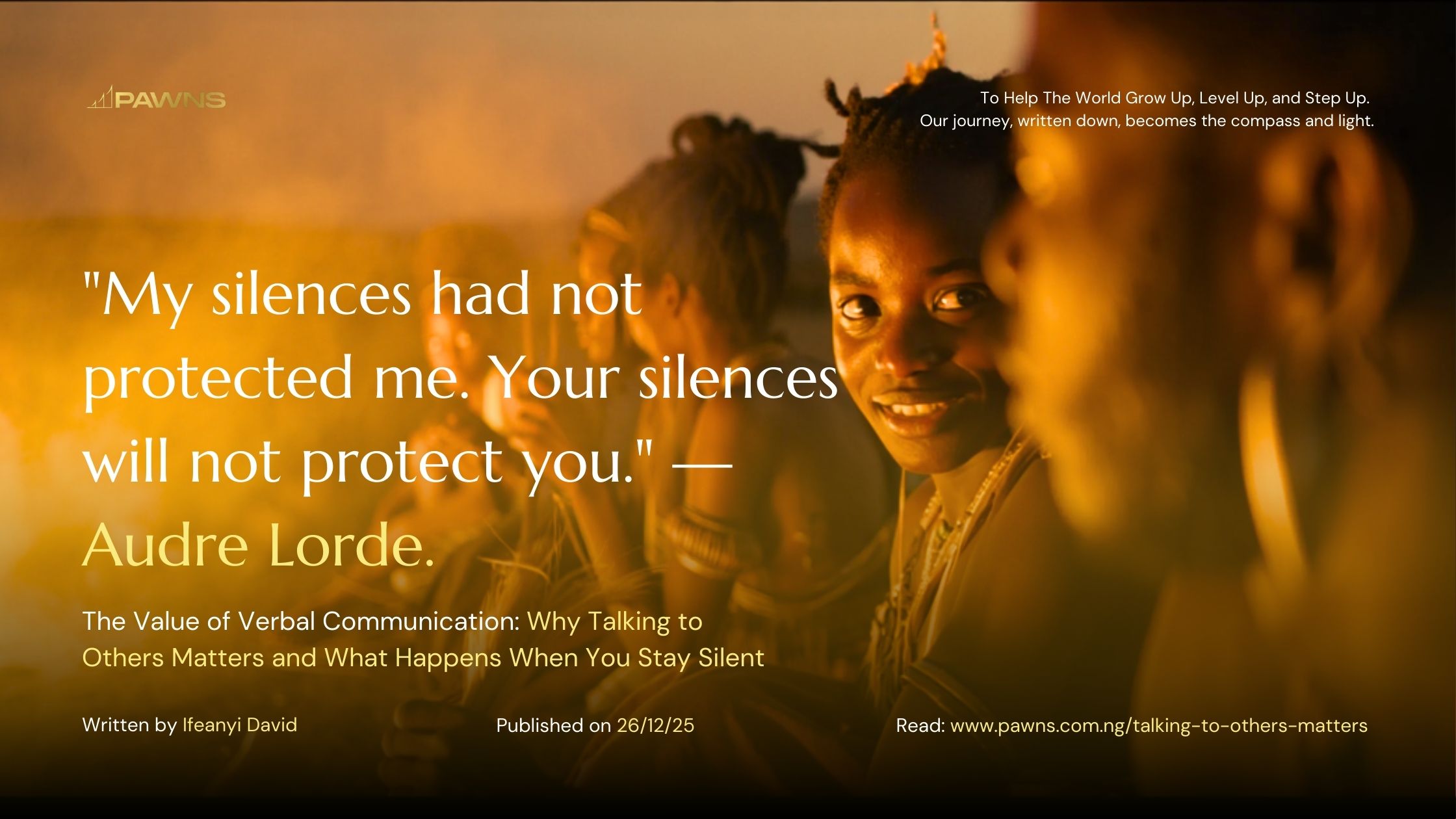
“My silences had not protected me. Your silences will not protect you.” — Audre Lorde.
Communication: Our Oldest Way of Overcoming Difficult Moments

I am not a big talker.
If I have something to say, I keep it brief. At other times, I say nothing at all.
For years, I thought this was a trait to be proud of in every circumstance. Then 2019 happened, and this inclination toward being a small talker nearly destroyed me.
If you’ve been keeping up with my writing, you should know the story: death anxiety. But maybe, not this part.
You see, I could not communicate the nightmares. I could not talk about petrification. I could not explain what it felt like to watch yourself come apart while everyone around you saw nothing wrong. By default, my response was to remain quiet, and it made everything worse.
The fear of dying only began to dissipate when I started talking about it.
First, with a friend I connected with on Facebook (someone I had never met in person until months had gone by). Then my mother. A, and finally, through writing, which is just another form of talking.
The act of getting it out, pulling the chaos from inside my head and putting it somewhere I could actually see it was how I began to overcome the fear. I share this because it’s not just my story.
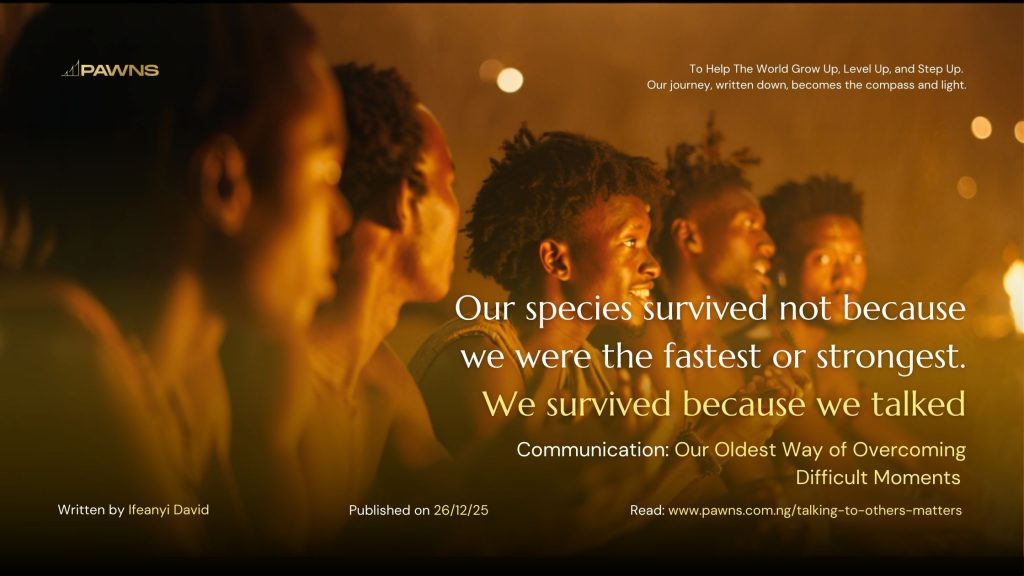
Our species survived not because we were the fastest or strongest. We survived because we talked—communicated better than any other creature on Earth.
When we were afraid, we gathered closer.
When the hunt failed, we shared the lesson(s).
When the weather turned, we warned each other.
The tribe that stayed silent died out.
The tribe that communicated survived.
The lone wolf strategy is a myth — even wolves hunt in packs.
We did not evolve to be fortresses; we evolved to be a network. Our survival advantage was not claws, wings, or speed. It was being synchronised with each other. Language, empathy, shared knowledge, and cooperation—these are what kept us alive.
Isolation is not natural for us. Neither is silence about what is happening in our heads. Bottling everything up fights against our design. The ability to say, “I need help,” “Give me that,” or “Let’s talk about it” is what sets us apart.
Sadly, we seem to have misguidedly labelled our greatest survival tool as a weakness. We have made vulnerability shameful. We call the sharing of thoughts and fears “soft.”
“Vulnerability is not weakness. It’s our most accurate measure of courage. Are we willing to show up and be seen when we can’t control the outcome?” — Brené Brown
What Happens When We Don’t Speak: The Cost of Silence

Data speaks truth:
Isolation kills as much as obesity.
Loneliness is deadlier than smoking 15 cigarettes a day.
People without social bonds are likely to die earlier, regardless of health, wealth, or status.
We weren’t built to keep quiet and figure it out alone.
When we don’t speak, we deteriorate.
When we don’t speak clearly, we ruminate endlessly.
The brain wasn’t built to hold everything in; it needs an outlet. Talking is how we expel the chaotic swarm in our heads and make sense of it.
Our internal monologues are messy by default. But when we speak, we’re forced to choose words, complete thoughts, hear how they land, signal our tribe, survive and thrive.
This process pulls ideas from the background to the foreground, where they can be seen, understood, and tackled. But when everything is bottled up, those unprocessed thoughts don’t disappear.
They tangle like ropes.
Fester like pests, and.
Turn toxic, like hemlock.
If your thoughts feel messy, talk about them. Whatever you feel while talking is a part of the process — it is not something to be ashamed of.
Speaking is maintenance. It’s how you untangle the knots.
Conclusion: Talk To Someone

The strong, silent type were likely the ones who died alone in a cave, while the “weak” ones who asked for help gathered and built civilisations.
So here’s what to do: Identify one person you can think out loud with.
Let them know you’re not necessarily seeking advice; just a safe space to speak.
It could be a close friend, a partner, a therapist, or even your favourite AI.
Schedule 20 minutes this week.
Don’t implode.
Vent.
Because the most dangerous place your thoughts can live is in your head: alone, unspoken, unprocessed.
You weren’t designed for that.
None of us were.
***
Thank you for reading to the end. If you found this helpful, please share it with family, friends, or a colleague who might need or appreciate these ideas.
Here are some blog posts you might find interesting:
- How To Overcome Shyness [And Attract People]
- How To Build Social Connections (With 13 Conversation Ideas)
- Atelophobia: Conquer Your Fear of Imperfection with These 5 Tips
- Askophobia: 5 Tips To Overcome Your Fear of Asking For What You Want
- Pistanthrophobia: Overcome Your Fear of Trusting Others With These 10 Tips


David Ifeanyi is a mindful SEO content writer, photographer, and photo retoucher with over 3 years of experience.
His works help people value themselves and their experiences more. Over the years he has inspired countless people to embrace their uniqueness and become better versions of themselves.
David has worked with several brands, including Tobi Digitals, ReelCliq, and Black Aperture. And has been a huge player in the growth of Pawns Digital Agency.
I love how you talk about real life issues and solutions.
I have been thinking about this and I’m glad to see that you share the same thoughts with me.
We’re glad it helped.
And we hope your mind finds some calm too.
Take care of yourself.