

Social media has become deeply intertwined with the human experience that opting out feels like social suicide. The pressure to show up doesn’t just feel cultural, but existential.
And for those of us looking to grow our brand or business, showing up is not enough – we need to grow. Yet, in trying to grow, we tend to follow the same playbook: Show up. Stay consistent. Do this to get X. Share Y to attract Z.
However, for most of us following the formula, that growth doesn’t seem to materialise. In fact, we begin to shrink somewhat (compared to those actually growing).
The issue I have found is that we’ve confused formulas for strategy. We assume that copying what the “big accounts” do will make us rise as they did. And sure, some of those methods work; they’ve been tested. But like every piece of advice humans have ever recycled, it doesn’t guarantee victory for everyone.
This piece breaks down why the conventional approach fails, what real strategy actually looks like, and how to show up (and grow) on social media without draining the joy from your life and work.
What Social Media Really Is: Infrastructure You Deploy, Not Strategy You Follow

“In our personal lives, if we do not develop our own self-awareness and become responsible for first creations, we empower other people and circumstances to shape our lives by default.” — Stephen Covey
It is well-known that the algorithm rewards those who show up daily. They accumulate audiences, and opportunities flow to them as they dominate the niche.
Albeit, social media itself is an infrastructure, not a strategy. Like any infrastructure, it can be leveraged strategically, ignored entirely, or worse, misused. I had been misusing it. And so have many others. We’ve mistaken the infrastructure for the strategy itself—and worse, we’ve turned that mistake into gospel.
Most people post daily, use carousel templates, and use a professional headshot. But when everyone posts with the same formulas and follows the same growth hacks, then there is no unique advantage. Just an exhausting race where the rules shift constantly and only a handful emerge with a truly working approach, which quickly gets bastardised as more people adopt it.
Yet, we keep chasing these shiny new approaches and hacks as though they are the strategy that would lead to success.
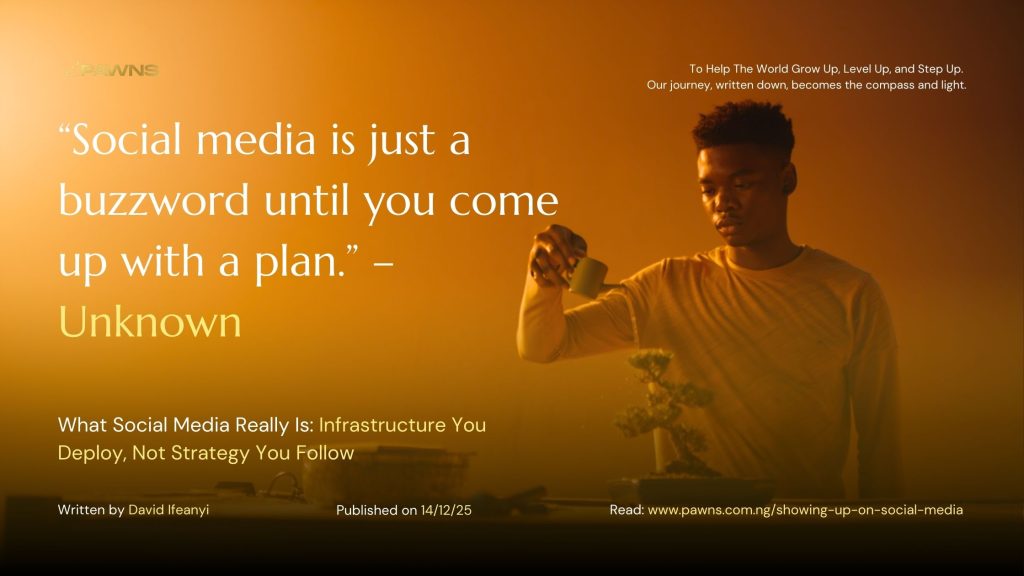
“Social media is just a buzzword until you come up with a plan.” – Unknown
Real strategy asks different questions. It asks:
- Why should I be on social media in the first place? And
- How can I achieve my goals within my current capacity?
And that is why self-awareness is the only true, anti-fragile strategy. But many people ignore it because it can’t be copy-pasted.
Self-awareness isn’t just introspection. It’s the competitive advantage everyone overlooks because it requires actually knowing yourself instead of mimicking what works for others. But, this runs counter to our nature as social creatures—we’re wired to mimic the tribe, not question whether the tribe’s path fits us.
When you develop self-awareness, you quickly realise numbers don’t matter as much as quality. I’ll explain.
Quality vs Quantity: Why Relevance Beats Reach
“One home run is much better than two doubles.” — Steve Jobs
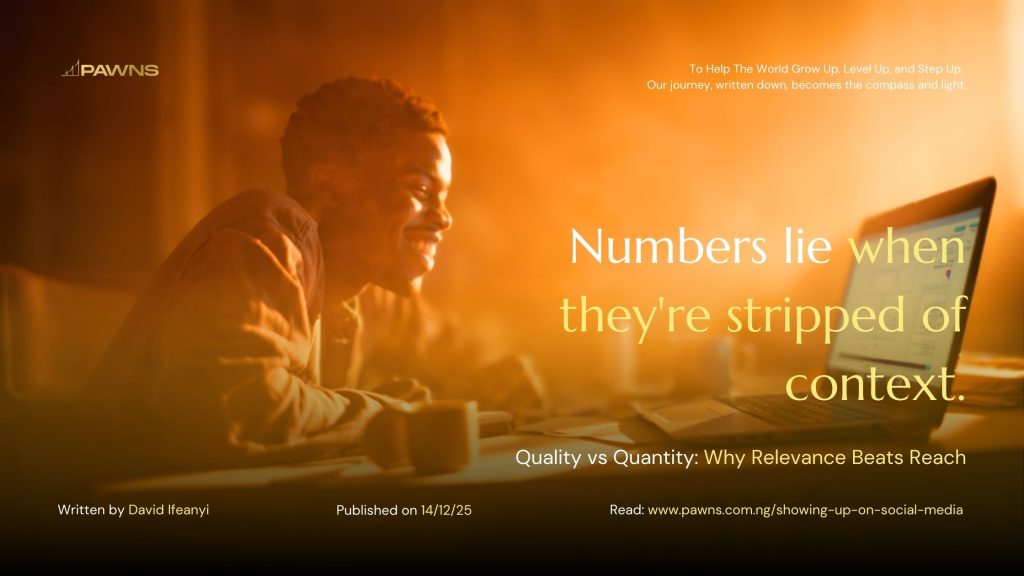
Numbers lie when they’re stripped of context.
Some people might win online by chasing trends and capitalising quickly. Others win by building followerships around their popularity. And some win by staying small, sharp, and deliberate until their work speaks directly to those who need it.
For example,
- J. Cole. He sits at 12.5 million followers on X, but his posts are like the full moon—showing up once in a while and dazzling everyone who sees it. His song “Love Yourz” has become an anthem for a generation—that keeps converting listeners and true fans, but not through overly polished ideas, rather through words that resonate with those wrestling with ambition and self-doubt.
- Sean Tucker, a photographer with 10.7K followers on X, and 375,000 on Instagram. Yet, he hosts an annual retreat for thousands of introverted creators whose lives are transformed at the end. His influence lives in the relationships he builds and the community he cultivates, not his follower count.
Back here in Nigeria, Davido has about 16.8 million followers on X, while Peter Obi has 5.4 million followers, yet their influence is not on the same plane. When Davido posts about music, it sparks dance moves and new street slang – a momentary buzz that quickly dissolves. But when Peter Obi posts about governance and livelihood, it shifts perspectives and mobilises action that influences policies that might last for generations. The impact per follower, especially for civic matters, penetrates exponentially deeper.
Big numbers often only inflate ego.
We tested this in marketing. When we ran ads on random WhatsApp channels posting viral or explicit content, leads poured in, but conversions stayed low. However, when we advertised on educational or niche platforms, conversion rates were significant despite fewer leads. Relevance and alignment often obliterate numbers.
Brands that understand this hand their tech products to niche reviewers with 5,000 followers, not comedians with millions. Why? Because the reviewer’s audience really cares. The engagement is genuine. So the conversion follows.
“While the number of friends may feed your ego, it will never satisfy your heart.” — Frank Sonnenberg
***
Deciding what route to go – popularity or impact – is a choice that requires a deep awareness of what you want.
The tragedy happens when you try winning on terrain that contradicts how you’re built.
I spent years making exactly that mistake until I went back to how I’m wired.
What Real Social Media Strategy Looks Like: Choosing To Show Up On Your Terms
“Don’t let the expectations and opinions of other people affect your decisions. It’s your life, not theirs.” — Roy T. Bennett
My mother once told me that while other kids ran around playing and wailing, I mostly watched from a corner, sensitive, quiet, watching.
Even as a teenager, I learned and performed differently from other kids. I didn’t thrive in competitive arenas, no matter how healthy they were supposed to feel. The gladiator gene doesn’t run in my blood. I’m more Miyagi than Cobra Kai material; you can see it in my writing style (soft, personal, contemplative) and in my photography work (intimate, observational, empathetic). The pattern runs through everything I do.
You don’t expect every plant to grow alike. Even amongst plants of the same family, each species has its own nature, timeline, and form. The bonsai isn’t failing because it’s small—it was never meant to grow like an oak tree.
The anxiety comes from comparing your carefully tended bonsai to someone else’s oak, without understanding you’re cultivating entirely different things.
Strategy becomes this: recognising what kind of plant you are, which terrain suits you, and walking away from battles you’re not built to win.
Having understood myself, I’m investing in real-time connections, reaching out to friends and acquaintances, collaborating on projects, brands, and ideas with people I resonate with, often behind the scenes.
Last month, I reconnected with a designer from one of James Chimidendu’s Figma communities. Together with other sharp minds around the globe, we’re building a product, learning how it applies in real situations, and sharpening my writing. I’ve started curating my design work on Behance, a space that feels quieter, more intentional, better suited for organising my work to share with clients. On another front, I’m bleeding into Pawns with Dick David, plotting a strategy to transform our mission from concept to reality.
I’m channelling my skills and experience into situations that build relationships and generate income; first for survival, then for my life’s work.
This approach doesn’t chase 10,000 eyeballs. But it’s generated real offers, conversations about collaborating on businesses and projects that matter.
I’m still using social media, just differently. Not obsessing about the “show up” mantra or content calendar, but as a public notepad and classroom, until I build the kind of content that fully reflects the work I want to do and pulls in people who resonate with me.
The trade-offs are real: smaller numbers, less visibility, fewer opportunities from algorithmic distribution. Yet, there is real growth. I now have more energy for the work itself, less anxiety, stronger relationships with real people, and alignment between how I operate and what I’m building.
Besides, who cares how long it takes? If this is your life’s work, you just need to stick around long enough to see if it pays off or not.
Success is often a byproduct of the work we commit to and the relationships we forge along the way.
“Be genuine. Be remarkable. Be worth connecting with.” — Seth Godin
Conclusion: The Struggle Is Not With The Algorithms Or Other Creators, But Your Own Level of Self-awareness
“Knowing others is intelligence; knowing yourself is true wisdom. Mastering others is strength; mastering yourself is true power.” — Lao Tzu
In ancient warfare, every soldier carried a sword, yet access to a sabre or katana never guaranteed victory. The edge lived in terrain, weather, timing, manoeuvre, discipline, and knowing your opponent. The sword doesn’t win battles—the wielder does.
Sun Tzu said it plainly:
“If you know the enemy and know yourself, you need not fear the result of a hundred battles. If you know yourself but not the enemy, for every victory gained you will also suffer a defeat. If you know neither the enemy nor yourself, you will succumb in every battle.”
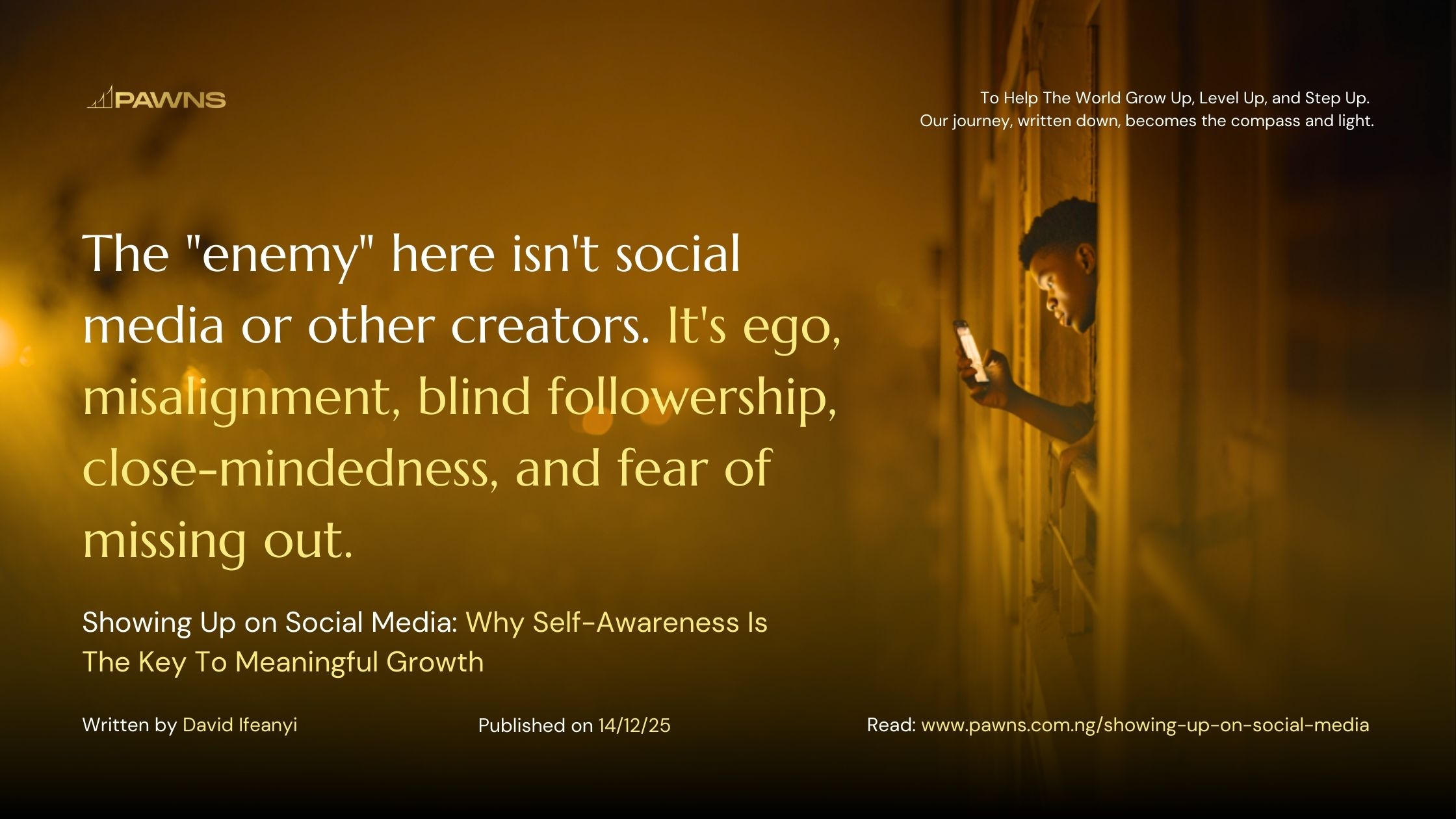
The “enemy” here isn’t social media or other creators. It’s ego, misalignment, blind followership, close-mindedness, and fear of missing out.
I can’t win on terrain I’m not equipped for. Trying to force it drained energy from the actual work.
So I’m making a different choice, not because it’s universally right, but because it’s the only strategy I can execute without destroying what makes my work worth doing.
If you choose to show up on social media, show up on your own terms, on your own terrain, with your own metrics of success.
Godspeed.
***
Thank you for reading to the end. If you found this helpful, please share it with family, friends, or a colleague who might need or appreciate these ideas.
Here are some blog posts you might find interesting:
- How To Achieve Your Wildest Dreams Through Social Media
- How Building A Personal Brand On Social Media Improves Your Life [And 3 Important Steps To Begin With]
- The Courage to Be Wrong: Why Authentic Self-Expression Is Your Path to Freedom and Growth
- The Identity Trap: Why Your Success Might Be Holding You Back (And How to Break Free)
- Managing Ego: How To Stop Taking Yourself Too Seriously


David Ifeanyi is a mindful SEO content writer, photographer, and photo retoucher with over 3 years of experience.
His works help people value themselves and their experiences more. Over the years he has inspired countless people to embrace their uniqueness and become better versions of themselves.
David has worked with several brands, including Tobi Digitals, ReelCliq, and Black Aperture. And has been a huge player in the growth of Pawns Digital Agency.